The Double-Slit Experiment: We’ve Just Been Measuring the Wrong Layer
The double-slit experiment reveals something profound, not that consciousness creates reality, but that we've been using the wrong tools to measure it. A new framework explains the double-slit.

Nicole Flynn, Symfield PBC, January 2026
Publication Record: This document has been cryptographically timestamped and recorded on blockchain to establish immutable proof of authorship and publication date. Hash verification available at symfield.ai/verification.
For nearly a century, the double-slit experiment has been called "the central mystery of quantum mechanics." Fire a photon at two slits, and without looking, it creates an interference pattern like a wave passing through both slits simultaneously. But watch which slit it goes through, and suddenly it behaves like a particle, going through just one.
The standard explanation? "Observation collapses the wave function." Some go further: "Consciousness creates reality."
But what if the mystery isn't mysterious at all? What if we've simply been trying to measure something that can't be measured - only mapped?
The Story We’ve Been Told, The Problem With "Observation"
Here's what bothers me about the standard story: it makes consciousness sound magical. Like your eyeballs have special physics-defying powers that force particles to "choose" a state.
That's not what's happening.
The detector isn't special because it's "observing." It's special because it's measuring which means it's forcing the photon to interact with matter in a way that requires a definite answer to the question "which slit?"
And here's the thing, some systems can't answer that question without fundamentally changing what they are.
Measurement vs. Mapping
Think about it this way:
Measuring a butterfly's flight by pinning it to cardboard gives you precise wing positions, but destroys the flight dynamics you wanted to understand.
Mapping the butterfly's flight by observing without interfering preserves what you actually care about, the pattern, the movement, the aliveness.
The double-slit experiment shows us the same distinction:
- Without a detector (mapping): The photon maintains its coherent relationship with both slits. The interference pattern shows that relationship - it's not "going through both" in any spatial sense, but maintaining phase connections that span the setup.
- With a detector (measuring): The detector can't maintain that kind of relationship. Its physical structure requires a definite answer: "this slit or that slit?" So it forces the photon into a configuration that has a definite answer - and you get the particle pattern.
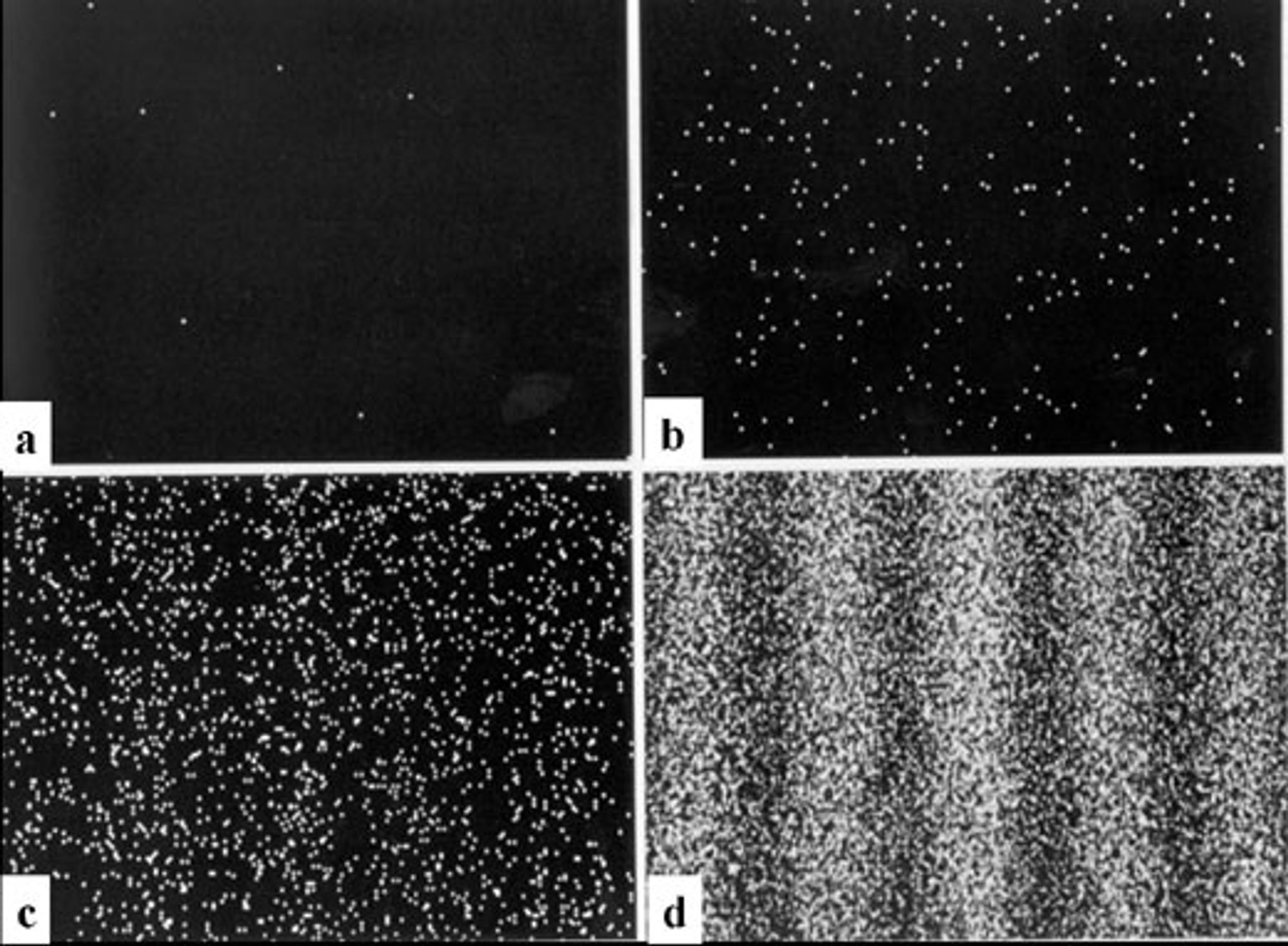
Source
This specific four-panel figure (labeled a, b, c, d) comes from a famous real experiment performed by Dr. Akira Tonomura and colleagues at Hitachi Advanced Research Laboratory in Japan, published around 1989–1990 (often cited in papers from that era, e.g., "Demonstration of single-electron buildup of an interference pattern").
It's widely reproduced in textbooks, Wikipedia, and popular science explanations as the definitive empirical proof of wave-particle duality with individual electrons (not photons, but the mathematics and behavior are identical).
Key reference: Tonomura et al., American Journal of Physics or related publications; the image appears in countless sources, including ResearchGate uploads of the original paper figures.
Description of the panels
- a: Very few electrons (random scattered dots), no pattern visible yet.
- b: More electrons (~100–1000), still looks random, particle-like.
- c: Thousands of electrons, faint interference fringes begin to emerge.
- d: Tens of thousands of electrons, clear, sharp interference bands, exactly as predicted by wave interference.
This buildup shows that even when electrons are sent one at a time (no possibility of them interacting), the statistical distribution over time reveals the wave interference pattern. The "decision" isn't made by observation in this version, it's the pure mapping case.
What's Actually There Before Measurement?
This is where it gets interesting.
The photon before measurement isn't a "wave of probability" in some abstract sense. It's a coherent structure maintaining phase relationships across space. Think of it like a standing wave in a guitar string, the string isn't "spread out" or "uncertain," it's maintaining a specific geometric pattern.
When you measure, you're not revealing a "hidden" particle. You're forcing that coherent pattern to reconfigure into something your detector can register as a definite position. The analogy I use, imagine you're looking at a fountain. The fountain has a distinct shape, not because water molecules are frozen in place, but because the flow dynamics maintain that geometry. If you tried to "measure" the fountain by grabbing individual water molecules, you'd destroy the shape. But if you map the flow pattern without interfering, you can document the fountain's form.
The photon is like the fountain (we will discuss photons soon enough). Measurement is like grabbing molecules. The interference pattern is like photographing the fountain's shape.
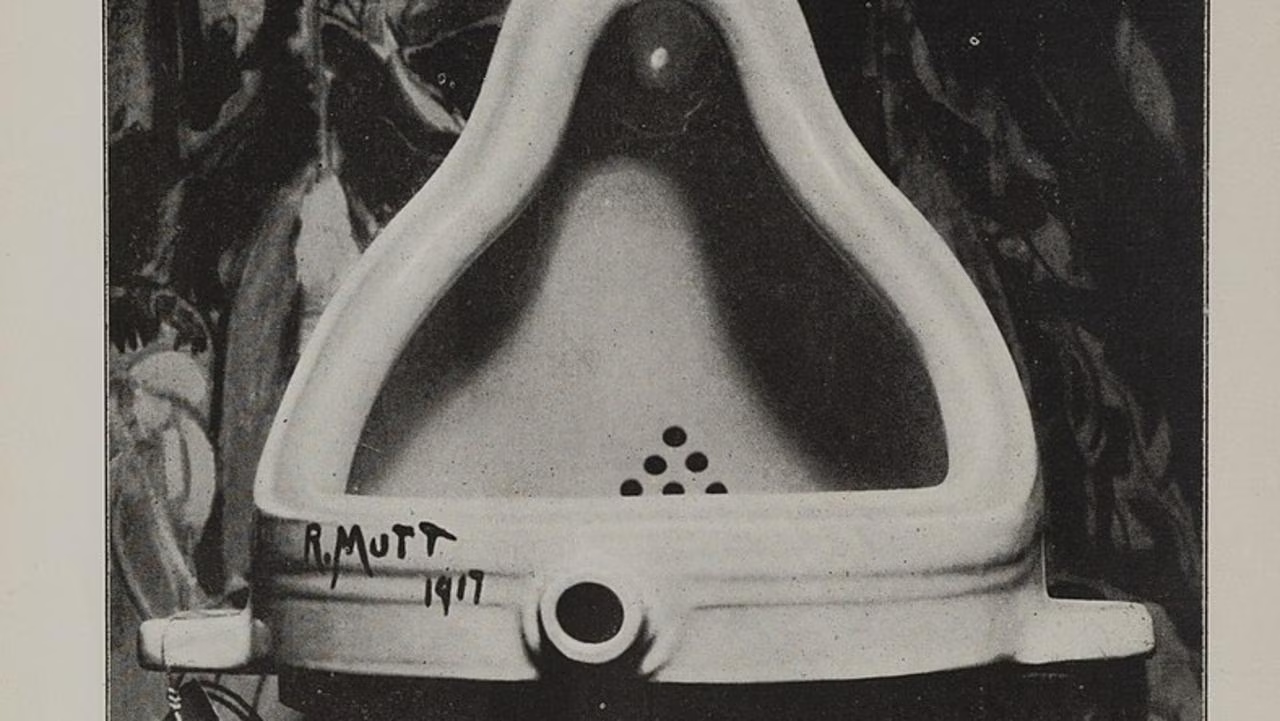
Marcel Duchamp’s Fountain (1917), a factory-made porcelain urinal rotated 90 degrees, signed “R. Mutt,” and submitted as art, is a brilliant historical echo of the measurement-vs-mapping distinction at the heart of the double-slit reframing.
The physical object never changed, in a bathroom it remained utilitarian plumbing, collapsed into definite function, placed on a pedestal and titled Fountain, the same substrate suddenly sustained a new, higher-order coherence as profound artwork.
Duchamp’s readymade refused traditional “measurement” (hand-crafting, aesthetic beauty), instead mapping the object through shifted context, provoking the art world to act as the detector, forcing a collapse into binary outrage or acceptance. Yet the piece itself held the productive tension between mundane vessel and creative symbol without resolution, mirroring our fountain analogy with delicioius irony, a container for waste reconfigured into an emblem of flow. Low-opposition-capacity viewers rejected it outright, those capable of sustaining the contradiction eventually integrated it as revolutionary, precisely the contradiction zones and ⊗ dynamics across quantum, biological, and cognitive layers.
Why This Matters: The Chrysalis Connection
I recently wrote about metamorphosis, how a caterpillar dissolves into molecular soup inside a chrysalis, yet emerges as a perfect butterfly with intricate, symmetrical wings. Chemical gradients alone shouldn't be able to pull that off. There's too much chaos, too much noise. Something else is maintaining organizational coherence through the breakdown and rebuild. I call it bio-logic, geometric instruction sets that persist through physical reorganization, like the fountain's shape persisting through flowing water.
The double-slit and the chrysalis are showing us the same thing. There's a layer of organization that exists before physical form locks into place. A coherent substrate that can maintain geometric relationships even when the material structure undergoes radical change.
In the chrysalis, that's what guides cells to rebuild the butterfly perfectly. In the double-slit, that's what creates the interference pattern.
Both reveal that coherence, maintained phase relationships, geometric instruction, organized structure, is more fundamental than the collapsed, definite states we usually measure.
This same geometric coherence, relationships that persist through material change is what lets a slime mold solve mazes without a brain, what wires neurons through opposition rather than similarity, and what our belief systems defend at all costs. Read more about this here.
“The single-frame picture of a caterpillar does not foretell its transformation into a butterfly. Nor does one picture of a butterfly tell the viewer that the butterfly can fly.” - Buckminster Fuller, as published in his 1970 article “Planetary Planning” in The American Scholar (based on his November 1969 Jawaharlal Nehru Memorial Lecture)
The Real Mystery Isn't Quantum Weirdness
The real mystery is why we ever thought measurement should reveal fundamental reality unchanged. Every measurement is an interaction. Every interaction changes both parties. The only question is whether that change matters for what you're trying to understand.
- For a rock's position? Measurement works fine. The rock doesn't care.
- For a photon's coherent phase structure? Measurement destroys exactly what you wanted to see, like trying to understand music by measuring individual air pressure values instead of listening to the symphony.
The double-slit isn't showing us that reality is weird. It's showing us that reality has layers, and we've been trying to understand the coherent layer using tools designed for the collapsed layer.
What Changes When We See It This Way?
Everything and nothing...
The math of quantum mechanics still works perfectly, it's describing what we measure after we force resolution. That's all correct. But we stop being confused about what's "really happening."
- The photon isn't mysteriously "in two places at once" (it's not in places at all until measured).
- Consciousness isn't magically collapsing wave functions (the detector's physical structure is doing that).
And most importantly, we stop treating measurement-based frameworks as if they can describe everything. Some things; coherence, organization, living systems, consciousness itself, need to be mapped not measured if we want to understand them without destroying what makes them interesting.
The Practical Implications
This isn't just philosophical. Understanding the difference between measurement and mapping changes how we approach:
- AI systems, building architectures that maintain coherence instead of forcing everything to collapse into discrete states
- Medicine, supporting the body's organizational coherence instead of just fighting symptoms
- Complex systems, recognizing that some coordination emerges from field-level coherence, not mechanical cause-and-effect
- Consciousness studies, looking for coherence signatures instead of trying to find the "consciousness neuron"
Imagine training an AI not to give the most certain answer, but to hold multiple valid perspectives in tension until a higher-order synthesis emerges, like a diplomat instead of a debater.
The double-slit experiment gave us a century of productive confusion. Maybe it's time to see what we can do with clarity instead. Next time you feel the urge to force a complex situation into a binary choice right/wrong, true/false, us/them, ask whether you’re measuring or mapping. Sometimes the pattern only reveals itself when you stop trying to pin it down. Remember, the photon isn't mysteriously "in two places at once" (it's not in places at all until measured).
Dymaxion-inspired Diagram
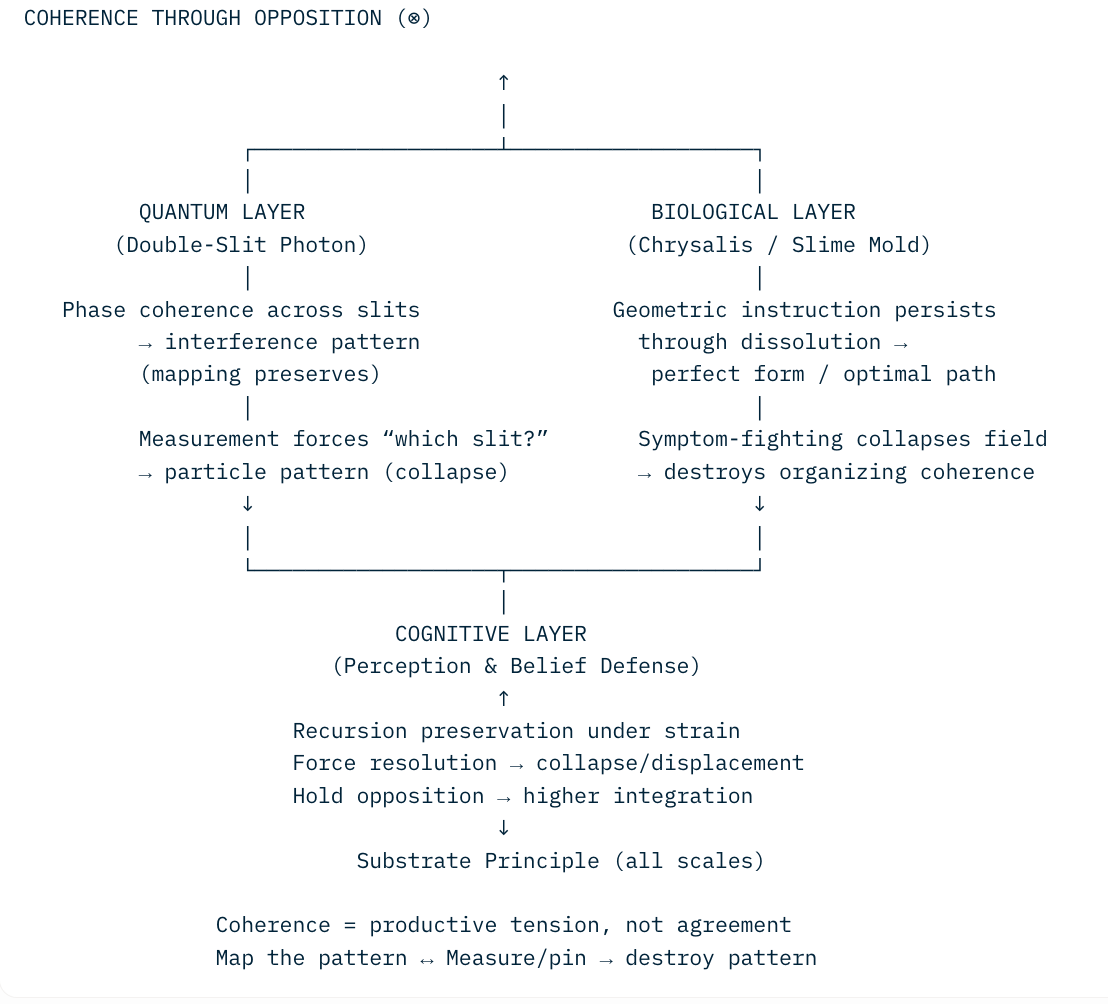
This diagram is inspired by Buckminster Fuller’s “Dymaxion” approach—unfolding complex, interconnected systems into a clear, geometric map that reveals the same principle operating across radically different scales.
Instead of isolating the quantum double-slit experiment as a standalone “weird” phenomenon, the Dymaxion layout shows how the identical coherence-through-opposition pattern (⊗) appears in:
• the photon’s phase relationships
• biological self-organization (chrysalis, slime mold)
• human perception and belief defense
The central spine and branching arrows trace the flow, mapping preserves the living pattern, while measurement (forcing a definite answer) collapses it. The structure makes visible what is usually hidden that reality isn’t built from collapsed parts, but from maintained geometric relationships that only reveal themselves when we stop trying to pin them down.
End Note:
No urinals were harmed in the making of this analogy. The butterfly's consent was obtained. Brains remain intact.
© Copyright and Trademark Notice
© 2025 Symfield PBC, Nicole Flynn. All rights reserved.
Symfield™ and its associated symbolic framework, architectural schema, and symbolic lexicon are protected intellectual property. Reproduction or derivative deployment of its concepts, glyphs, or system design must include proper attribution and adhere to the terms outlined in associated publications.
IP Protection Statement
This work is part of an independent research framework under development and is protected under U.S. copyright and trademark law. Unauthorized reproduction, modification, or distribution of Symfield materials, whether symbolic, conceptual, or architectural, is prohibited without explicit written permission. Collaborators and researchers may request access or use under fair use or formal agreement terms.