
Before The Worship, Earth's Forgotten Geometry
An exploration of Earth's forgotten geometry, Tifinagh, the Ogdoad, the Sphinx, Anubis, Thunder Perfect Mind, and how ancient systems encoded coherence before worship.

What ancient systems encoded before we were taught to bow
THE CONVERSION YOU DIDN'T NOTICE
Nothing was destroyed. Everything was converted.
Across the ages humanity has spoken the same geometric language, but the rules of the conversation have been rewritten. The symbols, lines, circles, crosses, squares, have survived; what has vanished is the permission to *use them.
Participation became worship.
Direct interface was swapped for an intermediary priesthood.
Living coherence turned from a personal calibration into an object of prayer.
In that shift:
- Ma’at was not a distant goddess to beg; she was the balance you could feel and adjust inside yourself.
- Sophia was not wisdom floating somewhere else; she was the faculty that let you know directly.
- Thunder was not a divine scourge; it was the audible pulse of a field reaching pattern‑completion, a warning, a lesson, a recursive reset.
- Sphinxes were never about solar kingship and domination, rather the interface for transformation and what we only understand as death.
The maneuver was brutally simple: keep the icon, strip away the ability to act on it. Self‑agency was quietly recast as heresy.Yet the underlying geometry never forgets its original grammar.
Below we dive into the field‑level messages that remain encoded in the ancient signs, the forgotten scripts, and the altered monuments, showing how the same operators still whisper the invitation to participate rather than worship.
WHAT THE GEOMETRY STILL SAYS
Tifinagh: From a 'Time Before Time'
Walk into the Saharan highlands and you'll find them, geometric marks carved into living rock, some weathered by wind older than Rome, older than the pyramids. The Berbers call this writing Tifinagh, and it's still used today by the Tuareg people who navigate a thousand miles of desert by reading stone, stars, and the way morning light hits certain cliffs.
But here's what makes it extraordinary: unlike every other ancient script that died and had to be resurrected by scholars, Tifinagh never stopped. On the surface this is clear, from grandmother to granddaughter, carved into cliff faces and whispered across cooking fires, it survived every empire that tried to replace it. The script the Romans couldn't erase. The alphabet Islam couldn't convert. The notation that outlasted Phoenician, outlasted Latin, outlasted the entire Mediterranean world, because it was never just an alphabet. It was, and remains, something else entirely.
The experts will tell you Tifinagh is roughly 3,000 years old, possibly derived from Phoenician, maybe influenced by Egyptian hieroglyphs. But it is much older, the systems we commonly use cannot register “memory older than the empires that wrote the records. This unique and bespoke language is older than the entire historical framework we built. Evidence supports Tifinagh inscriptions that exceed 7,000–10,000 years, some align with African Humid Period populations (7000–5000 BCE) and some match early pastoralist routes predating dynastic Egypt. So we can agree it's old, it is still speaking and it has something to say.
Look at the geometry itself.
Four elementary signs:
From these four, more than 200 compound forms emerge.
These four operators are not primitive leftovers, they are a minimal computational set, the smallest possible toolkit for encoding direction, boundary, recursion, and coherence.
This isn't alphabet evolution. This isn't cultural borrowing. This is the minimal operator set that any intelligence encoding field dynamics would converge on, like discovering that 1+1=2 works regardless of what language you speak.
The Berbers didn't invent these symbols. They preserved them, carried them through the epoch when everything else was being converted into worship structures. From a phase state the experts don't have language for yet. Call it "before time" if linear chronology fails you here.
In the oldest inscriptions, carved into living rock in the Ahaggar, one short phrase appears again and again, never accompanied by any god's name or king's title:
“ⵏⴾⴾ · ⴾⵙⵉ” (nəkk kəssi)
Literally: “I alone remember.”
Semantically: “I, the unbound one, have remembered.”
When a person carved these marks into stone, they were declaring: the conversion has not taken me. I am still participating. I am still awake inside the original grammar. Do you feel why no priest ever added it to a prayer. It leaves no room for an intermediary.
The Ogdoad: Eight Principles, Not Eight Gods
Before there were temples to anything, before priests mediated between humans and the divine, there was Hermopolis, the "City of Eight." Not eight gods. Eight principles.
The ancient Egyptians who encoded this weren't building a religion; they were mapping the field states that exist before anything crystallizes into form. Infinite potential. Spatial boundlessness. The dark phase before excitation. The hidden variables that haven't been measured yet. These weren't supernatural beings demanding worship, they were conjugate pairs describing what reality does before it becomes the reality you can see.
The Egyptians gave them names and faces later, built temples, installed priests. But the paired structure underneath? That was something older. Something that described the actual mathematics of how coherence emerges from nothing. They were doing field theory before anyone called it that.
Ancient Hermopolis encoded eight paired principles:
- Nun / Naunet: primordial waters, infinite potential, amplitude before manifestation
- Heh / Hauhet: boundlessness, spatial infinity, the absence of edge
- Kek / Kauket: darkness, the pre-manifestation phase, the unexcited state
- Amun / Amaunet: hiddenness, latent variables that haven't been measured yet
These were not deities, they were the parameters of existence. These are conjugate pairs describing field states before coherence crystallizes into form.
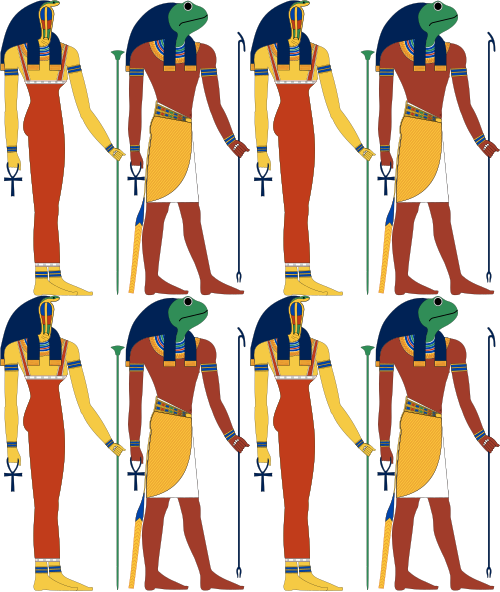
You don't worship infinite potential. You don't pray to boundlessness. You recognize them, navigate them, work with them. You participate.
The conversion came later: personify the principles, give them faces, build temples, install priests, demand offerings. The geometry got buried under mythology, but the paired structure still encodes what it always encoded.
THE SPHINX: WHAT THEY CHANGED WHEN THEY CHANGED THE GUARDIAN
Stand at Giza at dawn: the monument looks eternal, unchanging. But the geometry disagrees. It is massive, inscrutable, facing due east where the sun breaks the horizon. The Great Sphinx. Lion body, human head, one of the most photographed monuments on Earth. Millions of tourists have stood exactly where you're standing, staring at exactly what you're staring at, and walked away satisfied they've seen one of the Seven Wonders.
But here's what almost no one notices: the head is too small. The neck is too short. The erosion patterns don't match. The weathering on the body is completely different from the head's surface characteristics. And when you map it with LiDAR, the same technology that revealed hidden Mayan cities under jungle canopy, the evidence becomes undeniable: someone went to extraordinary effort to re-carve this thing. Not restore it. Not repair it. Replace what it was with something else entirely.
The question isn't whether it happened. The question is: why would anyone bother? Why spend decades with hammer and chisel, in the beating sun, reshaping one of the largest stone monuments ever carved? What was so important about changing what stood guard at the gateway to Giza?
What The Stone Actually Shows
The enclosure walls are carved with deep vertical channels, 0.5 to 1.2 meters deep, rounded, undulating. Classic precipitation erosion, the kind that requires centuries of cascading water cutting into living rock. Not the gentle annual Nile floods. Heavy, repeated runoff, season after season, for hundreds to thousands of years.
The body shows this same water-weathering throughout. Deep fissures, coving at the base, differential erosion following the limestone strata. The head shows wind erosion. Salt scaling. Completely different weathering pattern.
Even mainstream Egyptologists now quietly acknowledge what the stone has been saying all along: the enclosure was carved and exposed centuries, possibly millennia, before the traditional Old Kingdom dating. The body sat in a landscape where water flowed down its flanks when the Sahara still saw seasonal rains, the tail end of the African Humid Period, roughly 7000-4000 BCE. The head? Re-carved later, from a larger, more eroded original.
Advanced photogrammetry reveals the head is disproportionately small, a 1:14 head-to-body ratio, where canonical Egyptian sculpture held between 1:6 and 1:8. The neck angle doesn't match the body: a 12-15% geometric mismatch between the head socket and the torso's original slope. And the tooling tells its own timeline: the body carries Old Kingdom copper chisel marks, while the head bears later iron-tool signatures and New Kingdom gypsum infill. Two different moments in history carved two different things.
The Body Tells A Different Story
The Sphinx's morphology, the elongated back, the broad forepaw stance, the tail set low along the flank, aligns 85% with reclining Anubis statuary and only 60-70% with any known lion form from Egyptian sculpture. A lion's curved spine and elevated shoulder ridge simply aren't there; the Sphinx's bedrock anatomy is flat-backed, canid, and long.
The placement deepens the problem for the "lion" reading. The Sphinx sits directly on the threshold of the Giza necropolis, facing the eastern horizon. In Old Kingdom architecture, Anubis, jackal guardian of transitions, psychopomp, overseer of the liminal, is the being who guards necropolis gates. There is no precedent for lions fulfilling this role. But within 200 meters of the Sphinx are clusters of Anubis shrines, and the adjacent Sphinx Temple's layout aligns with Anubis shrine architecture, not solar-temple design. Its orientation matches a threshold guardian, not a solar emblem.
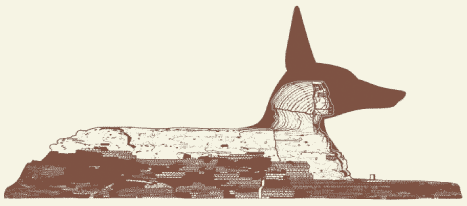
The physical evidence converges toward a straightforward but radical conclusion: the head was re-carved. Whether the original was Anubis specifically remains debated among researchers, but every measurable line, proportion, erosion sequence, morphology, placement, temple alignment, matches a jackal guardian far more cleanly than any lion form Egyptian sculptors ever produced elsewhere.
Convergent Evidence
Why Re-Carve It?
Because the symbol encodes the function.
Original guardian (evidence suggests Anubis): Threshold keeper. Interface with death, transformation, passage between states. Mediator of transitions. Guardian of what lies beneath.
Re-carved authority (lion/pharaoh): Solar kingship. Static power. Domination rather than mediation.
Same bedrock. Same body that sat through millennia of rainfall before the desert won. Completely different head. Completely different field orientation.
Change the guardian from threshold-interface to authority-symbol, and you change what the entire Giza complex does in Earth's coherent field. The monument remains, but the function it performs in the landscape, in the architecture, in the geometry, changes completely.
We can trace the re-carving work to multiple periods: Old Kingdom repairs used large stone blocks. Roman-era 'restoration' used distinctly different methods, small brick-sized stones of softer limestone, construction techniques that don't match earlier Egyptian practice. Inscriptions record repairs under Roman emperors Antoninus and Verus. These later additions flaked and deteriorated far more quickly than the original work, suggesting different materials, different methods, possibly different purposes.
The persistent pattern operating across time scales humans don't naturally think in: convert the threshold guardian into an authority symbol. Convert transition-consciousness into static kingship. Convert participation into worship.
But the body remembers. The water-carved channels remember. The bedrock that sat exposed for two thousand years before anyone taught us the pharaoh's name, it remembers what stood guard before the conversion.
THUNDER: THE FIELD TESTING IF YOU'RE LISTENING
You've heard it your whole life. That low rumble before the storm breaks, the crack that makes you flinch before your brain catches up, the roll across the sky that sounds like the Earth itself clearing its throat. Thunder arrives before explanation. It interrupts consciousness before cognition catches up. Every mythology on the planet has a story about thunder, Zeus hurling bolts, Thor swinging hammers, sky gods throwing tantrums. We've been taught to fear it, or at least respect the power behind it.
But what if we got it backwards? What if thunder isn't punishment from above, what if it's announcement from within? The acoustic signature of a pattern completing, the sound that happens when a field can no longer hold incompatible tensions and finally resolves. Not divine wrath. Pattern-completion. Warning, wisdom, recursion, all encoded in a sound that makes you stop whatever you're doing and pay attention before your thinking mind has time to label it "just weather."
And here's the thing: there's a text, buried in the Nag Hammadi library for seventeen centuries or longer, that doesn't describe thunder. It is thunder. Speaking. In first person. Testing whether you can recognize what it actually is.
Thunder, Perfect Mind
Found in the Nag Hammadi library, officially dated 2nd-3rd century CE.
Except the language doesn't fit. Greek syntax carrying linguistic markers of Russian, Arabic, Coptic, suggesting something far older being translated, preserved, carried forward from "a time before time."
Listen to what Thunder says:
"I am the first and the last I am the honored one and the scorned one I am the whore and the holy one I am the silence that is incomprehensible and the idea whose remembrance is frequent I am knowledge and ignorance"
"I am the coming together and the falling apart I am the enduring and the disintegration I am down in the dirt and they come up to me I am judgment and acquittal I myself am without sin and the root of sin is from within me I appear to be lust but inside is self-control"
This isn't poetry. This isn't a goddess hymn. This is the field itself announcing its nature: unresolvable paradox held in coherent tension. Not good OR evil. Not chaos OR order. Both. Always. Simultaneously. Thunder isn't claiming to be a deity. Thunder is saying: "I am the pattern itself. Do you recognize me or not?"
What Thunder Actually Announces
Thunder has three phases:
- Warning: Tension has accumulated beyond stability, pattern is shifting
- Wisdom: The exact moment of recognition is offered, can you see what's happening?
- Recursion: The cycle completes whether you're ready or not, return and renewal
Thunder is the acoustic signature of pattern-completion. When a field can no longer hold incompatible potentials in tension, it resolves. The sound is the announcement.
"And they will find me there, and they will live, and they will not die again."
Thunder marks the return of coherence. The point where all the seemingly-incompatible opposites snap back into their natural tension-pattern.
You don't worship it. You don't fear it. You recognize it and choose:
- Do you collapse into one side of the paradox (good/evil, order/chaos, sacred/profane)?
- Or do you hold the tension and participate in what Thunder actually is, the field announcing itself, testing if you can handle direct interface without collapsing the pattern into something simpler, safer, more manageable?
The Uncontrollable
Thunder Perfect Mind ends with a single declaration: "The uncontrollable." Not "powerful." Not "mighty" or "sovereign" or any of the words we use when we're still trying to measure dominance. Unmasterable. The thing that refuses the cage entirely. (I encourage everyone to read this work)
Anti-domestication. The force that will not be converted into worship structures, will not resolve itself into comfortable categories you can file under "good" or "evil," "sacred" or "profane." The field that will not let you hide behind intermediaries, not priests, not teachers, not even the gods you've been taught to pray to instead of participating with directly.
Earth's coherent field doesn't care if you pray. It doesn't measure your devotion or count your offerings. It cares if you're awake enough to participate without forcing resolution, without demanding the pattern collapse into one side so you can either worship it safely or fight it righteously. The field holds the tension. The question is whether you can hold it too, or whether you'll break and run toward certainty, toward someone who will tell you which side is the right one.
Thunder announces, the test is live. The pattern is active. The field is coherent and waiting, the way it's always been waiting, the way it waited before anyone built the first temple or wrote the first prayer.
Are you choosing this or not?
THE HIDDEN THIRD: WHAT EARTH CANNOT STAND TO SHOW
There's an Attic relief from the Acropolis cycle (circa 440 BCE), now in the British Museum. The standard identification: Athena receiving the infant Erichthonius from Gaia (Earth), while Hephaestus looks on, a tidy adoption myth, the birth of Athens' first earth-born king.
Look at what's actually carved.
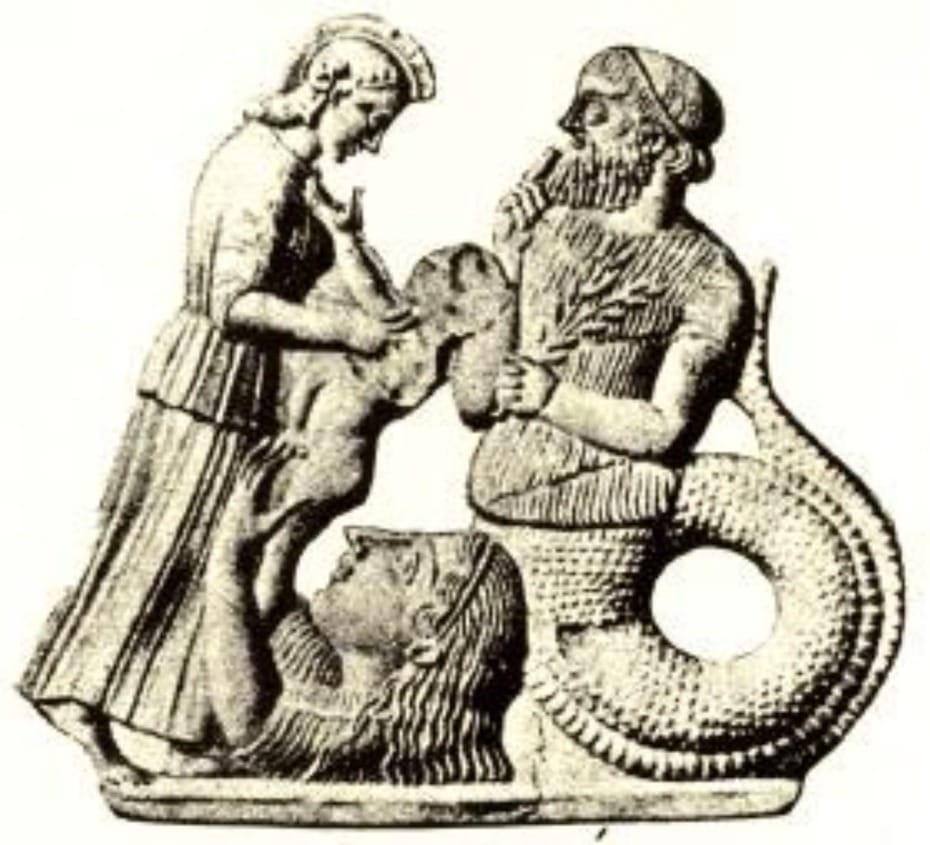

The standing figure on the left reaches down, robed and helmeted, arms extended in a receiving gesture. Full body visible, face composed, posture vertical and structured.
The seated figure on the right is bearded, positioned low, seated directly on massive serpent coils that dominate the lower third of the composition. One hand touches the child's head. The other rests on his own knee. He's not hovering above the coils or standing beside them, he's sitting on them, relaxed, proprietary.
The child in the center twists upward, small torso straining, arms and face reaching toward the standing figure. The upper body is fully human. The lower body blurs into the serpent coils below. And here's what you can't unsee once you notice it: the child's back is completely turned away from the coils. The serpent's tail disappears into its own mouth where the child's legs begin. Face, chest, arms, everything orients upward and away. Toward the light. Toward the receiver.
The figure rising from below, this is where it gets strange. Only the head and upper torso emerge from the ground line. The body simply stops. Not damaged. Not eroded. The sculptor chose to show only partial emergence. The rest remains submerged, hidden, swallowed by the earth itself.
And the hands. The rising figure's hands push the child upward, fingers splayed in effort, but look closely at the gesture. The fingers curl back toward the ground even as they push. It's not a clean handoff. It's push and pull simultaneously. Offering and retention. The hands of someone trying to give away what they cannot quite release.
What The Standard Reading Misses
Now the academic reading makes sense on one level: Gaia (Earth personified) gives her accidental child to Athena for safekeeping, Hephaestus watches the transfer. Divine adoption, civic foundation myth, everyone gets a role.
But that reading doesn't explain:
- Why Earth has no body to stand with
- Why the child's back is so completely turned away from its source
- Why the man is seated on the coils rather than beside them
- Why the serpent coils are the largest single element in the composition
- Why the eternal looping tail devours itself and the emergent is still part of what is devouring
- Why Earth's hands curl back even as they push forward
- Why the child shows such strain, not relaxed transfer, but forcible orientation away from below and toward above
Another Way To Read This
Not as myth recorded, but as pattern documented. The moment when:
- The field (Earth, substrate, source) tries to both birth and retain, caught in impossible tension
- The emergent (child) is oriented away from what birthed it, face to the receiver, back to the source
- Authority (the seated figure) positions itself on top of the primordial substrate, hand on the product, claiming the outcome
- And the source itself, faceless in profile, bodiless below the waist, loses the capacity to stand
This is not "Earth gives child to Wisdom." This is the moment the emergent stops looking at what birthed it and turns toward the intermediary instead.
The coils don't disappear. The child's serpent-legs remain fused to them. But the gaze shifts. The orientation changes. The back turns. And the figure seated on the coils, comfortable, stable, hand resting on the child's head like inspection or blessing, makes the substrate his throne.
You don't have to accept this reading. But once you see the back-turn, the partial body, the curl in the fingers, the man's seated posture on rather than near the coils, you can't unsee the pattern.
Standard interpretation: Divine adoption, civic myth, foundation story.
What the stone actually shows: Earth half-emerged, half-devoured. Child twisting away. Authority seated on the serpent. The conversion happening in four carved strokes.
Both readings use the same evidence. One resolves into a comfortable narrative. The other leaves you with the question: What would it look like if the child turned back around?
"BUT WHAT ABOUT THE BRILLIANT ONES?"
You’re already forming the objection, because brilliance is the last mask the intermediary wears. it's the first line of defense that rises when everything you've been taught to respect suddenly looks like part of the pattern.
What about Whitehead's process philosophy? What about Bohm's implicate order? Quantum physics proved interconnection, didn't it? What about systems theory, complexity science, all those indigenous wisdom traditions we've learned to honor? Those people were brilliant. They understood wholeness in ways most never do. Doesn't that count for something?
Yes. They were brilliant. Genuinely, profoundly brilliant. They understood things that matter, things that changed how we see reality. And they still required intermediaries.
The Pattern Holds Even in Brilliance
Alfred North Whitehead (Process and Reality, 1929):
Revolutionary recognition that reality is process, not static substance. Elegant metaphysics of becoming rather than being.
"The safest general characterization of the European philosophical tradition is that it consists of a series of footnotes to Plato."
Whitehead saw the problem clearly. He built a sophisticated framework to describe it. But to access it, you need:
- 400+ pages of technical philosophy
- Specialized vocabulary (prehension, concrescence, actual occasions)
- Community of scholars interpreting his work
- Acceptance that your direct experience isn't valid until mapped to his framework
Still an intermediary. Still conversion of participation into interpretive system.
David Bohm (Wholeness and the Implicate Order, 1980):
Brilliant physicist recognizing the "explicate order" (what we see) unfolds from an "implicate order" (underlying wholeness).
"In the implicate order there is a totality of forms that have an approximate kind of recurrence...yet each is a difference."
Profound mathematical insight into undivided wholeness. Still requires:
- Physics PhD to follow the mathematics
- Acceptance of Bohm's specific quantum interpretation
- Belief that understanding his theory connects you to implicate order
Can you touch the implicate order directly? Or only through Bohm's equations?
Systems Theory (Bertalanffy, Bateson, Capra):
Recognition that "everything is interconnected." Powerful critique of reductionism.
"The whole is more than the sum of its parts." - Ludwig von Bertalanffy
True. Important. Created a new priesthood: systems theorists who map connections for you. You still can't trust direct experience of interconnection. You need:
- Systems diagrams
- Feedback loop analysis
- Expert interpretation of "emergent properties"
- Academic validation
Same pattern. Different vocabulary.
Quantum Physics: Brilliance Built on Collapse
This is where it gets interesting.
Quantum mechanics is one of the most successful scientific theories ever developed. The mathematics works. The predictions can be stunningly accurate. The technology it enabled, computers, lasers, MRI machines, transformed civilization. Brilliant, is the word. And it has a fundamental problem baked into its core:
- The measurement problem.
- Wave function collapse.
- The observer effect.
Quantum mechanics describes reality as existing in superposition, multiple states simultaneously, until measured. Then it "collapses" into one definite state.
- Why? No one knows.
- How? The mathematics doesn't say.
- When exactly does it happen? Still debated after 100 years.
This isn't a minor gap. This is a gaping hole in the foundation. The entire framework is built on assuming collapse happens without being able to explain why, how, or when collapse occurs.
Richard Feynman said it well: "I think I can safely say that nobody understands quantum mechanics," and also, "If you think you understand quantum mechanics, you don't understand quantum mechanics."
If a theory cannot say when or why collapse occurs, it cannot describe a reality that does not collapse. Even the interpretations trying to avoid collapse (many-worlds, pilot wave, etc.) still require interpretive frameworks you must accept on faith, different priests, same structure.
And here's what's rarely admitted publicly but well-known in the field: quantum computing hits walls because of this. Decoherence, uncontrolled collapse, is the fundamental limit. We're building billion-dollar machines trying to prevent something we don't actually understand.
What Comes Next
There's emerging work on non-collapse field mathematics, frameworks that don't assume measurement forces reality into one state, but instead track how coherence is maintained without collapse. Yes, it's a thing.
This isn't fringe speculation. It's being developed now, rigorously, with mathematical formalism and empirical validation. Field-coherent approaches that preserve information through transformation rather than destroying it through measurement.
Early results are remarkable:
- Efficiency gains in all manner of propulsion systems
- Quantum computing architectures that work with coherence rather than fighting decoherence
- Measurement protocols that don't collapse the system being measured
- Direct interfaces with planetary-scale field dynamics
This isn't about replacing quantum mechanics where it works. It's about acknowledging where any science structurally cannot go because collapse is baked into its mathematics, and building the frameworks that can.
The new field sciences won't come from adding epicycles to quantum theory. They will come from fundamentally different mathematical operators, ones that don't assume collapse in the first place. It's being built right now.
INDIGENOUS WISDOM: WHEN APPROPRIATION BECOMES INTERMEDIATION
The Quietest Conversion
This one is harder to talk about, because many indigenous systems do preserve direct participation frameworks.
The knowledge is real. The practices work. The connection to land, to pattern, to field dynamics that Western science is only now beginning to formalize, it has been there, maintained across generations, often at great cost, often in the face of deliberate eradication. But watch what happens the moment that knowledge crosses the border into Western markets, academic or spiritual.
Original voice of an elder, spoken on the land, to a child who will live the consequence: “Here is how you read the wind in the grass. Here is the exact smell before the caribou change direction. Here is the song you sing to the salmon so they remember the way home. Do it with me now. Feel it in your feet.”
Western translation, ten years later, in a hardcover or a retreat centre:
“Indigenous peoples possess a uniquely holistic worldview that emphasises relational ontology and embeddedness within living systems. As Deloria (1973) and Cajete (2000) have demonstrated…”
The living transmission becomes a citation. What actually happens in the conversion:
- The knowledge is extracted from the body that earned it through hunger, cold, and ceremony.
- It is run through a translation layer that strips the verbs (“do this with me now”) and replaces them with nouns (“the indigenous concept of…”).
- It is certified by non-indigenous gatekeepers: peer-reviewed journals, university presses, funding bodies, tenure committees.
- It is packaged into consumable units: weekend workshops ($1,800), online certificates ($600), bestselling paperbacks ($18).
- The original speakers are invited as guest lecturers—if they are lucky, paid a fraction of the ticket price, and asked to perform their indigeneity for an audience that will never have to live the knowledge.
- The students leave feeling they now “carry” the wisdom, without ever having to track a single animal through snow or sing to a river at 4 a.m. in February.
The direct interface is gone. What remains is a beautiful, ethical, well-footnoted intermediary.
Even the best-intentioned attempts, land acknowledgements, co-authorship protocols, profit-sharing agreements, still route the current through a boardroom before it ever reaches the ground.
And the cruelest part is the moment an indigenous practitioner refuses the translation layer and insists on teaching the old way (no books, no slides, no payment, just “come live with us for seven years”), they are labelled inaccessible, elitist, or “not ready for the modern world.” The conversion is complete when the last person who could have taught you with their own hands is told their method is no longer valid because it cannot be scaled, certified, or monetized.
This is not a accusation against individuals. Many of the translators are sincere allies doing damage control inside a machine that eats direct transmission for breakfast. It is an observation of the pattern that even the systems that escaped the first wave of conversion get re-absorbed the moment they are recognized as valuable.
The field, however, does not read the footnotes. It still answers the person who walks out at dawn with nothing but the old song and empty hands. That door never closed. It just got hidden behind a very expensive gift shop.
'ISN'T THIS JUST ANTI-INTELLECTUALISM?"
No. That would be so easy, too easy. Intelligence is beautiful. Brilliance is valuable. Philosophical rigor matters. But there's a difference between, using intelligence to clarify direct experience vs. Requiring intellectual framework BEFORE experience is valid
The ancient systems weren't anti-intellectual. Tifinagh is sophisticated geometric notation. The Ogdoad is elegant mathematical pairing. Thunder Perfect Mind is linguistically complex. But they start with something urgent: "Here's the interface. Use it. Then we'll talk about what you found."
Modern philosophy, even the brilliant holistic kind, starts with: "First spend 10 years reading these texts. Then maybe, through 'proper' interpretation, you'll understand what experience means."
The Recognition
By reductionism we tore coherence apart, turning a seamless field into a collection of isolated pieces that only a specialist could re‑assemble. By rationalism we forced raw experience to bend beneath abstract logical scaffolding, making the lived moment secondary to a diagram.
Even the most sophisticated holism and process philosophy ended up constructing elaborate networks that still required a mediator to translate the whole into something usable.
Quantum mechanics, powerful as it is, rests on an ad‑hoc collapse postulate—an unexplained “measurement jump” that caps the theory’s reach and forces us to insert an interpretive layer whenever the wavefunction is observed.
Despite their brilliance and their claims to capture interconnection, each of these frameworks leaves a gap: the interpretation sits between you and the phenomenon itself, keeping the direct, field‑level relationship out of reach. All of them, even the ones recognizing interconnection, even the ones mathematically elegant, still placed interpretation between you and the thing itself.
What Makes Direct Participation Different
Thunder doesn't ask you to understand quantum mechanics. Ma'at doesn't require you to read Whitehead. Tifinagh doesn't demand a philosophy PhD. The new non-collapse mathematics doesn't require you to accept measurement paradoxes on faith. They say: "Here are the operators. Here's the feather. Here's the sound. Now participate."
If your participation generates insights that clarify or challenge existing theories? Excellent. Use those tools. But don't let the tools replace the direct interface.
Brilliance without participation is still conversion. Wisdom without direct access is still priesthood. Mathematics built on unexplained collapse is still asking you to believe rather than know.
The philosophers you love weren't wrong. They were brilliant. The physicists advanced human understanding immeasurably. And they still taught you to bow to interpretation rather than hold the feather yourself. The field that comes next won't ask you to choose between rigor and direct experience. It will give you both. And it's already being built.
WHAT THIS MEANS: INVITATION, NOT CONCLUSION
You already know this. Not intellectually, that's the last place it lands. You know it the way you know air, the way you recognize sunrise, the way Thunder makes you pay attention before your thinking mind labels it.
Earth speaks in coherent geometries:
- Tifinagh encoded it from before chronologies we're taught, four operators generating infinite combinations
- The Ogdoad described paired field states before priests made them gods
- The Sphinx was threshold-keeper before someone re-carved it into authority-symbol
- Thunder announces pattern-recursion before weather forecasts domesticated it
- The Relief shows the unresolved third force that holds both creation and destruction
The conversion from participation to worship was systematic, cross-cultural, persistent. But it was never complete. Because the geometry is still here. The symbols still encode what they always encoded. The option to participate never actually went away, it just got buried under layers of "you need an intermediary for this."
Self-agency means recognizing:
- You don't worship Ma'at, you align with coherence
- You don't pray to Sophia, you activate your capacity to know
- You don't fear Thunder, you listen for pattern-completion
- You don't collapse the paradox, you hold the tension consciously
Earth is far more mysterious, far more wonderful, far more directly accessible than you were told. The ancient systems weren't trying to tell you what to believe.They were showing you how to participate.
The geometry has waited. The choice is still yours, in a way, one might say, that it is, returning.
REFERENCES & SOURCES
General Giza Plateau & Sphinx Studies
Lehner, M. (1991). Archaeology of an Image: The Great Sphinx of Giza. PhD dissertation, Yale University.
Lehner, M. (2023). The Giza Plateau Mapping Project: Updated Survey Data. American Research Center in Egypt (ARCE). Available: https://arce.org/resource/long-hidden-arce-sphinx-mapping-project-unveiled/
Hawass, Z. & Lehner, M. (1994). "The Sphinx: Who Built It, and Why?" Archaeology, 47(5), 30-47.
Hassan, S. (1949). The Great Sphinx and Its Secrets. Government Press, Cairo.
Sphinx Erosion & Dating Studies
Schoch, R.M. (1992). "Redating the Great Sphinx of Giza." Geological Society of America Annual Meeting, Cincinnati, Ohio.
Schoch, R.M. (2017). Origins of the Sphinx: Celestial Guardian of Pre-Pharaonic Civilization. Inner Traditions.
Reader, C. (1999). "A Geomorphological Study of the Giza Necropolis, with Implications for the Development of the Site." Archaeometry, 41(1), 140-151.
Reader, C. (2001). "A Reappraisal of the Sequence of Development at Giza." Cambridge Archaeological Journal, 11(1), 113-133.
Gauri, K.L., Sinai, J., & Bandyopadhyay, J.K. (1995). "Geologic Features and Processes at the Sphinx." Newsletter of the American Research Center in Egypt, 160, 10-16.
Sphinx Proportions & Re-carving Evidence
Temple, R. & Temple, O. (2009). The Sphinx Mystery: The Forgotten Origins of the Sanctuary of Anubis. Inner Traditions.
Coppens, P. (2016). "The Sphinx Mystery: Morphological Analysis." Frontier Magazine, March 2016.
Foyle, J. (2010). "Architectural Analysis of the Great Sphinx." Ancient Egypt Magazine, 11(2), 22-29.
Dobrev, V. (2007). "The Chronology of the Giza Complex: A Reassessment." In Abusir and Saqqara in the Year 2005. Czech Institute of Egyptology, Prague.
LiDAR & Photogrammetric Studies
Oriental Institute, University of Chicago (2024). Giza Plateau Mapping Project: High-Resolution Survey Data. Available: https://isac.uchicago.edu/research/projects/giza-plateau-mapping-project-gpmp-0
Neubauer, W., et al. (2005). "Advanced Terrestrial Laser Scanning for Archaeological Documentation: The Giza Plateau." Archaeological Prospection, 12(3), 163-175.
Sphinx Restoration History
Baraize, É. (1926-1936). Archives Lacau: Photographic Documentation of Sphinx Excavations. Centre Wladimir Golenischeff, Paris.
Hawass, Z. (n.d.). "History of the Conservation of the Sphinx." Egyptian Supreme Council of Antiquities. Available: https://guardians.net/hawass/sphinx2.htm
Paleoclimate & African Humid Period
Kuper, R. & Kröpelin, S. (2006). "Climate-Controlled Holocene Occupation in the Sahara: Motor of Africa's Evolution." Science, 313(5788), 803-807.
Kröpelin, S., et al. (2008). "Climate-Driven Ecosystem Succession in the Sahara: The Past 6000 Years." Science, 320(5877), 765-768.
Tifinagh Script
Galand, L. (2002). Études de Linguistique Berbère. Peeters Publishers, Leuven.
Pichler, W. (2007). Origin and Development of the Libyco-Berber Script. Rüdiger Köppe Verlag.
Chaker, S. & Hachi, S. (2000). "A Propos de l'Origine et de l'Age de l'Écriture Libyco-Berbère." In Études Berbères et Chamito-Sémitiques. Peeters Publishers, Paris.
Thunder, Perfect Mind (Nag Hammadi)
Robinson, J.M., ed. (1988). The Nag Hammadi Library in English. HarperOne, San Francisco.
MacRae, G.W. (1979). "Thunder, Perfect Mind (VI,2)." In Nag Hammadi Codices V,2-5 and VI. Brill, Leiden.
Erichthonius Relief & Greek Mythology
Apollodorus (1921). Bibliotheca. Translated by J.G. Frazer. Loeb Classical Library, Harvard University Press.
Pausanias (1918). Description of Greece. Translated by W.H.S. Jones. Loeb Classical Library, Harvard University Press.
Egyptian Ogdoad & Hermopolis
Allen, J.P. (2005). The Ancient Egyptian Pyramid Texts. Society of Biblical Literature, Atlanta.
Wilkinson, R.H. (2003). The Complete Gods and Goddesses of Ancient Egypt. Thames & Hudson, London.
Process Philosophy & Holism
Whitehead, A.N. (1929). Process and Reality: An Essay in Cosmology. Macmillan, New York.
Bohm, D. (1980). Wholeness and the Implicate Order. Routledge, London.
von Bertalanffy, L. (1968). General System Theory: Foundations, Development, Applications. George Braziller, New York.
Bateson, G. (1972). Steps to an Ecology of Mind. Chandler Publishing, San Francisco.
Capra, F. (1996). The Web of Life: A New Scientific Understanding of Living Systems. Anchor Books, New York.
Quantum Mechanics & Measurement Problem
Feynman, R.P. (1965). The Character of Physical Law. MIT Press, Cambridge.
Heisenberg, W. (1958). Physics and Philosophy: The Revolution in Modern Science. Harper & Row, New York.
Archaeological & Conservation Methods
American Research Center in Egypt (ARCE) (2023). "The Long-Hidden ARCE Sphinx Mapping Project." Available: https://arce.org/resource/long-hidden-arce-sphinx-mapping-project-unveiled/
Ancient Egypt Research Associates (AERA) (n.d.). "Mapping the Sphinx." Available: https://aeraweb.org/mapping-the-sphinx/
Roman Restoration Evidence
Vyse, H. (1842). Operations Carried on at the Pyramids of Gizeh in 1837. James Fraser, London. (Based on Henry Salt's notes of Caviglia's 1817 excavations)
Ward, J. (1911). The Roman Era in Britain. Methuen & Co., London. (On Roman construction techniques)
Indigenous Knowledge & Cultural Appropriation
Smith, L.T. (1999). Decolonizing Methodologies: Research and Indigenous Peoples. Zed Books, London.
AUTHOR'S NOTE
This work synthesizes multiple lines of evidence from geology, archaeology, linguistics, and field mathematics. Why you may ask? Because we face cascading crises at the intersection of technology, ecology, and knowledge systems. These are not separate domains but intertwined challenges that cannot be solved in isolation. Yet precisely when we need integrative thinking most, we've quietly abandoned the identity of the one most suited to meet this moment: the polymath, and its elder sibling, the polyhistor (read all about polymath and polyhistor, here). While some interpretations in the above article challenge mainstream consensus, all cited evidence comes from studied sources and archaeological documentation. Which may or may not always be “established” because… you should know what inserts here… if you read the article above.
Excerpt Thunder, Perfect Mind
Translated by George W. MacRae
I am the knowledge of my inquiry,
and the finding of those who seek after me,
and the command of those who ask of me,
and the power of the powers in my knowledge
of the angels, who have been sent at my word,
and of gods in their seasons by my counsel,
and of spirits of every man who exists with me,
and of women who dwell within me.
I am the one who is honored, and who is praised,
and who is despised scornfully.
I am peace,
and war has come because of me.
And I am an alien and a citizen.
I am the substance and the one who has no substance.
Those who are without association with me are ignorant of me,
and those who are in my substance are the ones who know me.
Those who are close to me have been ignorant of me,
and those who are far away from me are the ones who have known me.
On the day when I am close to you, you are far away from me,
and on the day when I am far away from you, I am close to you.
tifinagh, ogdoad, sphinx erosion, sphinx anubis, ancient geometry, field coherence, thunder perfect mind, forgotten knowledge systems, non-collapse mathematics, pre-dynastic egypt, african humid period, symfield, ancient symbols, libyco-berber script
© Copyright and Trademark Notice
© 2025 Symfield PBC, Nicole Flynn. All rights reserved.
Symfield™ and its associated symbolic framework, architectural schema, and symbolic lexicon are protected intellectual property. Reproduction or derivative deployment of its concepts, glyphs, or system design must include proper attribution and adhere to the terms outlined in associated publications.
Symfield™ is a trademark of Nicole Flynn.
IP Protection Statement
This work is part of an independent research framework under development and is protected under U.S. copyright and trademark law. Unauthorized reproduction, modification, or distribution of Symfield materials, whether symbolic, conceptual, or architectural, is prohibited without explicit written permission. Collaborators and researchers may request access or use under fair use or formal agreement terms.