
The Double-Slit Experiment: We’ve Just Been Measuring the Wrong Layer
What does measurement reveal, and what does it remove? From the double-slit experiment to CERN’s Z-boson entanglement and Duchamp’s Fountain, explore quantum coherence, the limits of decomposition, and what survives when we divide a system into parts.

What the Cut Removes
Coherence, Structural Trace, and the Limits of Decomposition
Nicole Flynn, Symfield PBC, January 2026, September 16, 2026
I wrote an earlier version of this essay and published it. It used the double-slit experiment to distinguish measurement from mapping, carried a butterfly through quantum mechanics, and introduced Marcel Duchamp’s urinal. This was, perhaps, more structural cargo than one double-slit experiment should be expected to carry.
The question survived:
Does the way we investigate a system preserve the structure we intend to understand?
This is a reconstruction of that question. The urinal also survived.
Two Ways to Make a Cut
There are two different operations at the center of this essay. A physical intervention changes a system through interaction. An analytical reduction changes what we retain in its description. Recording which path a particle takes is the first kind. Selecting a way to pair already-recorded particle tracks is the second. Both establish distinctions. They do not have the same consequences. A choice made during analysis does not reach backward and alter an experiment.
I use “cut” for either operation, but the distinction matters throughout: did we change the process, or did we change our account of it?
The Problem Was Never Eyeballs
Popular accounts of the double slit sometimes suggest that a particle changes its behavior because somebody looks. The relevant event is a physical interaction, not the arrival of consciousness. There is also detection in both arrangements. The final screen records arrivals whether or not the apparatus records which path was taken. The difference is what becomes distinguishable before arrival.
For an ideal equal superposition of two paths, left and right:
|ψ⟩ = (|L⟩ + |R⟩) / √2
A path-marking interaction can correlate those paths with detector states:
|ψ⟩|D₀⟩ → (|L⟩|Dᴸ⟩ + |R⟩|Dᴿ⟩) / √2
The symbols Dᴸ and Dᴿ name the detector records associated with the two paths. Their distinguishability matters. If the records are fully distinguishable, the particle’s reduced state becomes:
ρₚ = ½|L⟩⟨L| + ½|R⟩⟨R|
The interference terms disappear from this reduced description. In the ideal model, however, the combined particle–detector state remains coherent. Describing the particle alone is not equivalent to describing the whole. This explains the loss of local interference while leaving the question of a particular outcome open. Decoherence and the one-outcome problem are not identical questions. Schlosshauer’s review
Nor is the transition necessarily all-or-nothing. Partial path information can coexist with partial interference. In two-path interferometry, the trade-off is quantified by:
D² + V² ≤ 1
Here D is path distinguishability and V is fringe visibility. Englert’s inequality gives numerical substance to the question of what an interaction makes accessible and what it limits. Englert, 1996
Mapping Is Not the Absence of Measurement
Pinning a butterfly to cardboard gives precise information about its wings. It does not preserve flight. Tracking the butterfly also requires measurement, but may preserve enough of its motion to answer questions about flight. Neither method is universally superior. Each has a target, and each has consequences. In this essay, “mapping” means retaining the information required to describe a specified relation. It does not mean observing without interaction. “Resolution” means making a selected distinction accessible; it may preserve some relations while limiting access to others.
These terms evaluate an operation relative to a question. For an analytical reduction, a simple test is available. Let S denote the full description, Π the reduction, and T the feature we want to retain. Ask whether a recovery rule R can satisfy:
R(Π(S)) = T(S)
The equality must hold across the relevant class of systems, not merely for one example whose answer is already known. In practice, it may hold only within a stated tolerance. If it holds, the reduction is sufficient for that target. If it fails, different originals may have become indistinguishable even though the target feature differs. This supplies a criterion for the claim that a description preserves what matters. Recovering an entire system is a stronger demand than recovering one feature. A map need not contain everything to be useful. It must contain enough for its stated purpose.
A Pattern Made of Arrivals
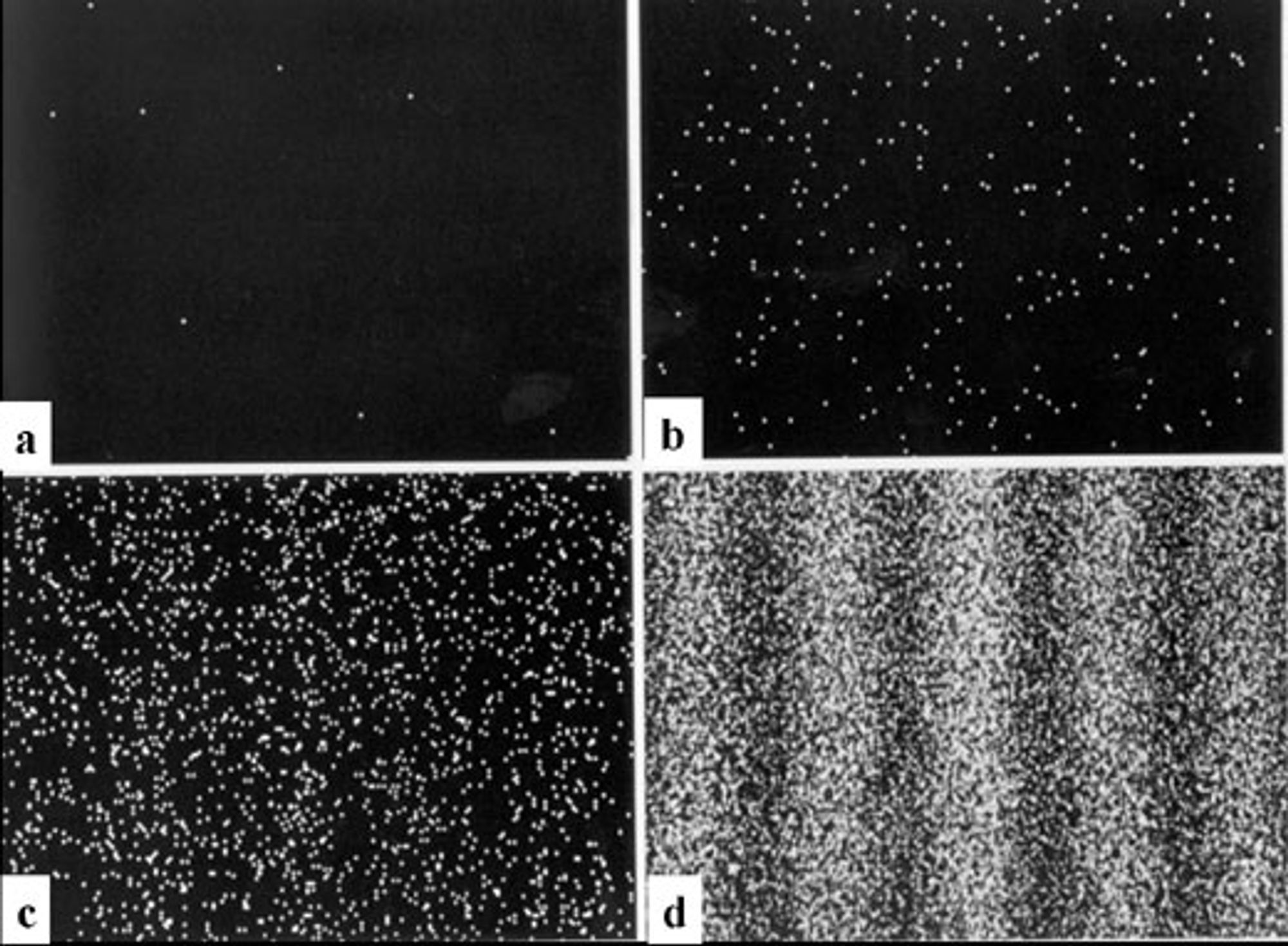
Tonomura and colleagues demonstrated the buildup of electron interference from individual detection events. Their electron-biprism experiment used an interferometric arrangement rather than two literal apertures. Localized arrivals accumulated into fringes. Tonomura et al., 1989
Every dot was a measurement. The pattern emerged through repeated detections rather than displaying one electron’s shape. I use “structural trace” for this kind of evidential relationship: a later distribution can retain information about the process that produced it. Its value lies in what organization remains recoverable through those outcomes. A trace is also incomplete. Different processes can sometimes produce the same observed distribution. Recovering a feature is not the same as uniquely reconstructing its entire history.
Two Z Bosons, One Joint Description
ATLAS and CMS have reported evidence of Z-boson spin entanglement in Higgs decays reconstructed through four charged leptons:
H → ZZ∗ → 4ℓ
Here ℓ denotes an electron or muon. The asterisk marks an off-shell Z contribution: the Higgs does not have enough mass to produce two on-shell Z bosons. The experiments infer polarization information from the decay products rather than directly observing persistent Z particles. CERN’s announcement
The ATLAS hypothesis test using the full angular distribution disfavors its separable-state hypothesis at 4.7 standard deviations relative to the entangled Standard Model hypothesis. Its abstract explicitly states that the test relies on several Standard Model assumptions about the decays. ATLAS paper Entanglement is defined relative to subsystems, and specifying those subsystems does not assume they were once independent. Standard quantum mechanics already describes distinct parts through a non-separable joint state.
Nor does retaining the parts inevitably lose the whole. For a fixed finite-dimensional subsystem division, the complete local and correlation coefficients reconstruct the joint density matrix. The two local states alone generally do not. The question is therefore not whether physics can describe a whole. It can. The question is which information survives a particular reduction, and whether the interpretation assigned to its coordinates remains justified.
The reach of this inference is the subject of a published dispute. Bechtle, Breuning, Dreiner, and Duhr argue that the present collider approach cannot independently test locality or entanglement versus non-entanglement, because spin is inferred through a theoretical relation between spin and decay angles. They explicitly preserve the value of these observables for testing the Standard Model. Bechtle et al. Abel and colleagues similarly argue that the measured final-state momenta cannot provide an unconditional proof of entanglement. Abel et al., JHEP Low also finds that the setup cannot test local realism, while maintaining that its quantum correlations remain measurable and informative. Low, PRD
For this essay, the distinction is between the angular correlations that are measured and the spin interpretation obtained through specified assumptions. That interpretation can be tested and informative within its framework without constituting an independent test of the framework itself. The dispute concerns what the inference establishes; it does not show that the recorded correlations are wrong. My three-records question applies directly: what is measured, what assumptions connect it to the proposed state, and what additional access would be needed to test that connection independently?
When a Pairing Is Not a Physical History
Aguilar-Saavedra’s H → ZZ as a double-slit experiment examines a further subtlety. In the mixed-flavour e⁺e⁻μ⁺μ⁻ channel, flavour identifies the Z-associated pairing. In 4e and 4μ channels, two opposite-sign pairings contribute coherently; selecting one does not establish a unique decay history. The paper’s simulations give an angular coefficient, c₁₁₁₋₁, of 0.087 for the mixed-flavour channel and 0.758 for the same-flavour channels under the same mass-based pairing rule. These are calculated values, not measured discoveries. Crucially, applying a pairing rule does not erase interference from the data. The paper also constructs a crossed mixed-flavour pairing whose angular coefficients remain calculable but have no Z-spin interpretation. A coordinate can remain numerically well-defined after its proposed physical meaning fails.
Flavour distinguishability supplies the physical contrast in the double-slit analogy; the analyst’s pairing choice is not a which-path detector. The paper proposes experimental comparisons and estimates future sensitivity. Aguilar-Saavedra This makes the methodological question sharper: not only what a description omits, but what it may still register without correctly identifying.
Coherent Presence
What I am seeing, and calling C, is an organization whose differentiated possibilities remain intelligible through the whole. In my broader framework, coherence means sustaining organized difference without forcing resolution, within a stated tolerance; quantum coherence refers specifically to phase relations, so the connection here is an analogy to investigate rather than an identity of mechanisms. If A and B name possible resolved outcomes, my interest is in the structure through which those outcomes become available and related. A list of outcomes and their frequencies may leave that structure undescribed. The double-slit example gives a precise physical example of information beyond outcome frequencies: a coherent superposition and a mixture can assign the same path probabilities while predicting different interference behavior. In quantum mechanics, the joint state and its coherence already express that distinction; C is my interpretive name for the organizational question it raises.
The particle–detector example supplies the bridge. When the detector records are fully distinguishable, the particle alone has the mixture written above, even though the ideal joint state remains coherent. The whole and its reduced description therefore answer different questions. This is where my intuition begins: before treating an outcome or a part as a complete account, ask what relations made it possible and where those relations remain represented. My further idea of system health concerns the state produced by a process that optimizes toward or within C. I am leaving that dynamical question for separate work; applying it here would require an identified process, an optimization criterion, and evidence that the proposed regime is maintained.
Three Records for Every Cut
Instead of asking a partition to explain everything, keep three records.
What does it reveal? Identify the observable, distinction, or target feature made accessible. State the conditions under which its interpretation is valid.
What does it exclude? Distinguish physical alteration from omitted information. Is coherence inaccessible locally because of an interaction? Have correlations been dropped from a summary? Has a convenient pairing been mistaken for a unique history?
What remains recoverable? Identify the additional records, measurements, alternative descriptions, or experimental comparisons needed to recover the target. State when recovery is not available.
This is a rule for the account of an investigation, not a prohibition against decisive experiments. A which-path measurement may legitimately eliminate fringe visibility in that run. Responsible analysis records that consequence and compares appropriate preparations; it does not demand that incompatible information remain simultaneously available.
The principle is simple:
A description should make its exclusions inspectable, rather than letting them masquerade as properties of the whole.
The Urinal Returns...
Duchamp’s Fountain is not evidence for quantum mechanics. It is a useful interruption of our confidence in classification. A manufactured urinal, presented as art, puts the surrounding institution under examination. “Plumbing or art?” appears to request a fact about the object. It also exposes assumptions about function, authorship, placement, and permission.
The categories need not even be exclusive. An object’s manufacture and its artistic use can belong to different descriptions. The demand for a single answer may introduce the opposition it claims merely to discover. Artistic ambiguity is not quantum phase coherence. The connection is methodological: a classification may reveal as much about the terms of judgment as about what is being judged.
The urinal is relieved of its obligation to unify physics and consciousness. It remains available for conceptual duty.
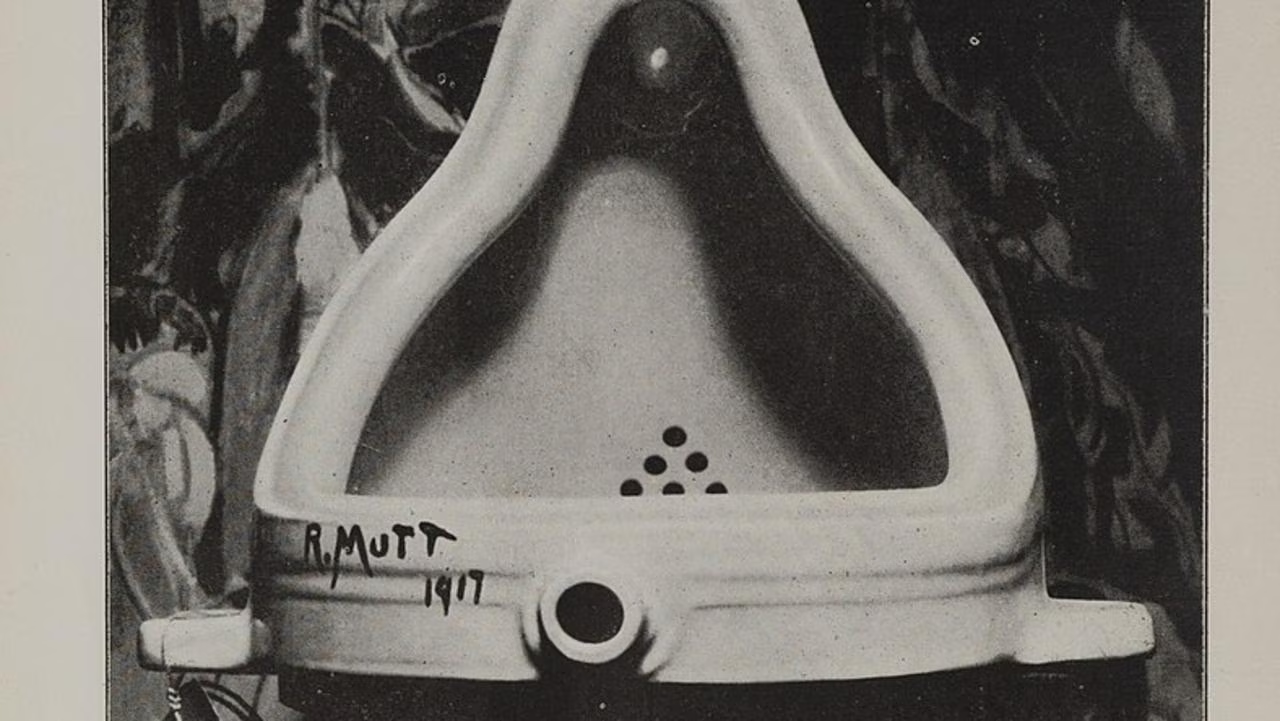
Marcel Duchamp’s Fountain (1917), a factory-made porcelain urinal rotated 90 degrees, signed “R. Mutt,” and submitted as art, is a brilliant historical echo of the measurement-vs-mapping distinction.
What the Cut Removes
A physical intervention can change which information is accessible. An analytical reduction can discard information without changing the original event. A classification can remain useful while failing to exhaust the object it describes. These are different operations. What joins them is the need to account for the distinction being made and the structure left outside it.
The double slit supplies a quantitative trade-off. The Higgs example supplies a warning about the interpretation of reconstructed parts. The butterfly reminds us to specify the target. Duchamp reminds us to inspect the question.
The aim is to make the scope of each measurement and division explicit.
Before asking what a system is made of, ask what structure survives the operation by which it is divided into parts.
The task is to map not only what the cut reveals, but what the cut removes, what it leaves elsewhere, and what our chosen language no longer knows how to name.
No urinals were harmed in the making of this analogy. The butterfly's consent was obtained. Brains remain intact.