
Palantir: The Company That Named Itself After a Warning
Every age elevates a form of vision and grants authority to whoever claims it: Lynceus aboard the Argo, Plato's philosopher, now Palantir, a company named after Tolkien's seeing-stones, quoting Wittgenstein to call itself "an N of 1." But the seeing-stones deceive their masters.

Plato, the Lyncean imperative, and the mathematics of perception
Every age elevates a form of vision and grants authority to whoever claims it: Lynceus aboard the Argo, Plato's philosopher, and now Palantir, a company named after Tolkien's seeing-stones that calls itself, quoting Wittgenstein, "an N of 1." But the seeing-stones deceive their masters. A claim to perceive what others cannot, hidden threats, concealed opportunities, the shape of the future itself. In Archaic Greece, that claim found its embodiment in Lynceus, the Argonaut whose legendary sight was said to penetrate earth, sea, and distance. In the twenty-first century, technology companies make comparable claims, not of supernatural vision, but of computational omniscience.
But what is this vision, really? Is it a matter of seeing more clearly? Or is it an act of construction? Lynceus emerged from the heroic traditions of Archaic Greece, when myth was becoming a shared cultural language for explaining authority, exploration, and human capability. His gift distinguished him even among heroes. Where Heracles embodied strength and Odysseus cunning, Lynceus embodied perception itself. Apollonius Rhodius, in the Argonautica (I.151–155), credits him with eyesight so keen that he could "easily direct his sight even beneath the earth"; later tradition held that he could see through the trunk of an oak and distinguish objects nine miles distant. He served as lookout aboard the Argo, indispensable to a voyage whose dangers were invisible until they were upon the crew.
His gift was more than a marvel. It encoded a political ideal, that true leadership depends on seeing past appearances. Kings relied on scouts. Generals relied on intelligence. Priests claimed access to divine knowledge. Lynceus compressed all of these functions into a single figure whose authority rested entirely on superior perception.
What makes Lynceus culturally significant is not his uniqueness but his recurrence. Every era produces its own version of the one who sees. The Greeks answered with divine sight, Lynceus, Teiresias, the oracle at Delphi. The Enlightenment answered with instruments, the telescope, the microscope, the empirical method that claimed to reveal nature's hidden mechanics. The twentieth century answered with intelligence agencies, institutions built on the premise that secret knowledge of enemies and allies alike could determine the difference between survival and catastrophe. The twenty-first century increasingly answers with artificial intelligence platforms, systems that promise to integrate vast datasets, detect patterns invisible to human analysts, and convert noise into operational certainty. The technology changes, the aspiration does not. In each case, a society designates a privileged observer whose vision allegedly exceeds ordinary human limits, and then invests that observer with authority on the strength of that claim. The supernatural gift of penetrating earth and distance becomes the integration of datasets, sensors, and machine learning. The vocabulary shifts from prophecy to operational intelligence. The underlying assertion is unchanged, a sufficiently privileged observer can perceive reality more completely than everyone else.
The deeper question is not who sees, but how the seeing works. In the Symfield reading of Plato, the theory of forms is not merely a metaphysical picture, it is an attempt at a mathematics of perception. Plato sought a system in which bias could be filtered out, in which the recursion of observation (perceiving, judging the perception, judging the judgment) could stabilize into a coherent reality rather than spiral into distortion. The divided line is precisely this, a hierarchy of perceptual reliability, ascending from shadow to image to object to form. And the cave, on this reading, is not only a parable of ignorance. It is a warning about what happens inside any system that collapses continuous reality into discrete shadows and then mistakes the shadows for the whole.
The modern Lyncean project is a continuation of this Platonic ambition. It is not enough to see, one must build the substrate that allows seeing to happen without collapse. This is where the modern parallel sharpens. Palantir sells a mathematics of perception. Its platforms claim to integrate fragmented data into a unified "ontology", a structured representation of reality that permits decision-making at scale. The language is technical, but the ambition is Platonic, to transform the shadows of raw data into the forms of operational truth.
The ascent Plato described was a discipline: a long, deliberate turning of the mind away from the shadows and toward the light, undertaken by few and never easily. What happens when that discipline is skipped, and the machinery of shadow-making is handed instead to systems that never made the climb?
"Building, at civilizational scale, a perceptual infrastructure shaped by minds that have not been through this training, deployed to populations that have had even less of it, is the configuration the cave was a warning about. It is not the cave being escaped. It is the cave being industrialized, better shadows, more responsive shadows, shadows that learn what each prisoner wants to see, distributed at a speed and scale Plato could not have imagined but whose structure he diagnosed precisely." — From, What Plato Was Actually Building: Mathematics, Perception, and the Bias Recursion
The name Palantir itself concedes the lineage. Names are intentional. Palantír is Tolkien's word for the "far-seeing" stones of Middle-earth, and in the source myth, the stones never lie. What they show, however, can be selected. Saruman and Denethor are undone not by false images but by true ones, curated by a stronger will to induce allegiance in one and despair in the other. The company named itself after a technology of vision whose defining lesson is that perfect perception does not protect the perceiver. It is difficult to imagine a more precise, or more inadvertent, restatement of the Lynceus problem.
In The Technological Republic: Hard Power, Soft Belief, and the Future of the West, Alex Karp and his co-author Nicholas W. Zamiska argue that technological capability should once again become inseparable from national purpose, that Silicon Valley abandoned its historic partnership with government, and that this abandonment has left the West strategically vulnerable. The book calls for a renewed union between the software industry and the state, with companies like Palantir positioned as essential architects of Western hard power.
In April 2026, the argument stepped off the page. Palantir posted a 22-point distillation of the book to X, "Because we get asked a lot. The Technological Republic, in brief", and the post drew more than 32 million views, along with coverage that ranged from sober investor analysis to open alarm. Point 5 declares that the question "is not whether A.I. weapons will be built, it is who will build them and for what purpose." Point 12 announces that "the atomic age is ending" and that a new era of deterrence built on AI is set to begin. These are not product claims. They are claims about who sees the future, and the document is best read whole in that light.
What emerges from the 22 points is not merely a policy platform but a creation myth. The sequence moves from diagnosis of civilizational decay, to the prescription of hard power, through a critique of contemporary culture and a redefinition of geopolitics, and culminates in a declaration of cultural hierarchy, diagnosis, then prescription, then revelation. Even the form participates in the argument. A book's continuous case, hundreds of pages of context, qualification, and history, is resolved into twenty-two discrete, numbered, actionable outputs and posted as pronouncement. Complexity in, certainty out. It is perhaps only coincidence that 22 is a number freighted in Western esoteric tradition, the letters of the Hebrew alphabet, the chapters of Revelation. But whether or not anyone at Palantir intended the resonance, the manifesto reads as scripture, numbered, complete, apocalyptic.
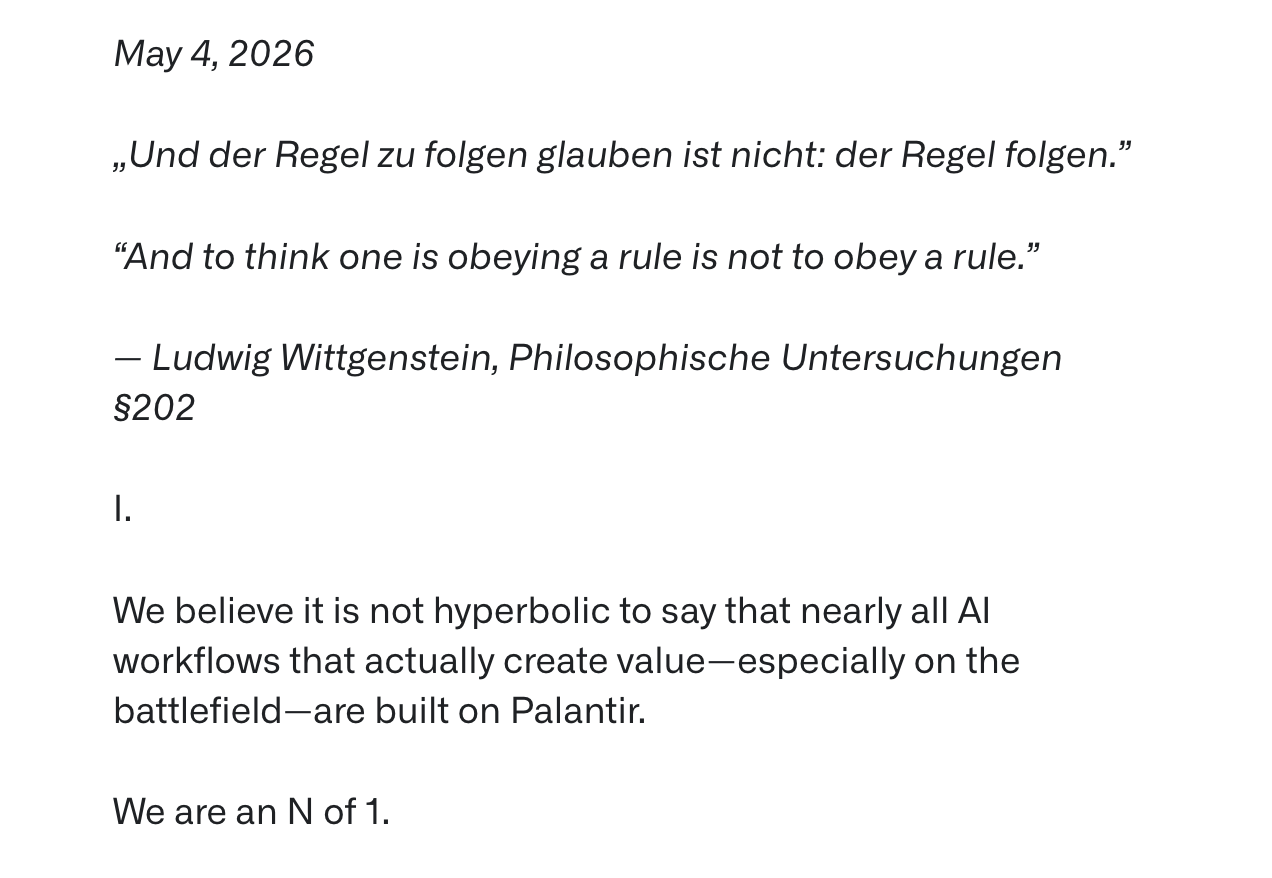
Even Palantir's shareholder communications carry the framing, and its most recent letter carries it furthest. The Q1 2026 letter, dated May 4, 2026, opens not with a number but with a philosopher: an epigraph from Wittgenstein, "to think one is obeying a rule is not to obey a rule", set above the results like scripture above a sermon. Then, on a line of its own, the company states what it takes itself to be: "We are an N of 1." A category with a single member. The lone observer, given its own line on the page.
The letter goes further and amends the philosopher, proposing "an addendum for AI": one must actually expose reality, not merely appear to do so. The move is quietly astonishing. Wittgenstein's passage argues that no one can privately certify their own correctness, that seeing rightly is a shared practice, never the possession of a single seer. Palantir invokes that text and then installs itself as precisely the authority Wittgenstein says cannot exist: the one that separates real sight from its imitation. Elsewhere the letter describes the company as "sentinels" standing "on the walls" against "the assault of AI slop," and frames its growth as "a phase shift, even sublimation", the lookout on the wall, guarding a vision only it can be trusted to hold. Earlier letters strike the same note more plainly: growth as a "cosmic reward" for backing an "admittedly idiosyncratic project," and, flatly, "we are in a category of our own."
Whether one agrees with these claims is almost secondary. What matters historically is that they revive one of civilization's oldest political archetypes, legitimacy grounded in superior perception. Palantir advances a philosophy about who should see, what they should see, and to what end, and that philosophy mirrors the ancient logic of Lynceus, the observer whose unique capacity justifies an irreplaceable role within the collective enterprise.
The structural parallels line up cleanly:
Greek culture understood that extraordinary sight carried extraordinary weight. To perceive hidden dangers meant bearing the responsibility of warning others. Vision was inseparable from power because information determined action, the lookout who spotted the reef had authority over the helmsman, the scout who detected the ambush shaped the general's strategy. In our modern institutions, data plays an analogous role. Organizations compete not only over physical resources but over who possesses the most comprehensive picture of events. Information becomes strategic terrain. The institution that sees more claims the right to decide more, and, increasingly, to act more.
This logic carries a corollary that Greek mythology explored unsparingly. If authority rests on vision, then the failure to see, or the inability to act on what is seen, undermines the entire basis of legitimacy. The seer who misreads the omen loses credibility. The scout who misses the approaching army loses the battle. The politics of perception are unforgiving. Greek mythology offers a caution that modern narratives omit. Lynceus dies. Despite his supernatural perception, through mountains, through earth, through the walls of the underworld, he is killed in a violent quarrel between his brother Idas and their cousins, the Dioscuri, Castor and Pollux. The dispute begins with a cattle raid. Idas tricks Castor and Pollux out of their share of the spoils. Tensions escalate. In Pindar's telling (Nemean 10), Lynceus uses his fabled sight to spot Castor hiding inside a hollow oak, seeing him from the peak of Mount Taygetus. But the knowledge does not prevent the catastrophe. Pollux kills Lynceus. Idas kills Castor. Zeus destroys Idas with a thunderbolt. Everyone dies.
The man who could see through stone could not see his way out of a family quarrel. This ending is not incidental. It is the myth's most serious commentary on the limits of perception. Vision alone is insufficient. Perfect observation does not guarantee good judgment. The ability to detect hidden objects cannot repair broken trust, resolve competing claims, or substitute for the political wisdom required to hold an alliance together. And there is a deeper lesson here. Lynceus saw objects, not relationships. He could locate Castor inside the oak, but the thing that actually mattered, the web of grievance, loyalty, and escalation binding the four men, was not something his sight could resolve. His gift reduced every situation to a single, actionable answer, a target located, a position confirmed. What destroyed him was everything that reduction left out.
That tension is as alive now as it was in Archaic Greece. Modern institutions pursue ever more comprehensive systems of observation, integration, and prediction. They promise clearer vision, greater certainty, more effective action. The myth of Lynceus reminds us that the aspiration is neither new nor uniquely modern. Societies have imagined it for nearly three millennia. What changes are the instruments, divine sight, telescopes, satellites, neural networks. What remains constant is the belief that somewhere there exists a vantage point from which the whole world can finally be seen.
The deeper question, the one the Greeks wrestled with, the one Plato tried to solve with mathematics, the one we have not resolved, is whether that belief is achievable, or even desirable. Can we build a mathematics of perception that does not distort what it claims to reveal? Can we create a system that sees the whole field and not just the object, that holds under strain instead of breaking? Lynceus saw everything. It was not enough. Every age elevates a form of vision and grants authority to whoever claims it: Lynceus aboard the Argo, Plato's philosopher, and now Palantir, a company named after Tolkien's seeing-stones that calls itself, quoting Wittgenstein, "an N of 1." But seeing is not judgment, and the seeing-stones deceive their masters. Perhaps the future belongs not to those who see the most, but to those who can hold uncertainty without collapsing it.
© 2026 Symfield PBC, Nicole Flynn. All rights reserved.
This work is part of an independent research framework under development and is protected under U.S. copyright and trademark law. Unauthorized reproduction, modification, or distribution of Symfield materials, whether symbolic, conceptual, or architectural, is prohibited without explicit written permission. Collaborators and researchers may request access or use under fair use or formal agreement terms.