
Perturbation as Language: From Living Geometry to Ancient Communication
Proto-Elamite tablets have resisted decipherment for a century. What if we've been looking for the wrong kind of language? Exploring perturbation-based encoding.

A continuation of "Vibration Holds Geometry: Why Structure Needs Noise to Stay Alive
In my previous article, I argued that perturbation, what we often label noise, error, or imperfection, is not a defect in coherent systems. It is the condition that keeps them alive. Perfect symmetry carries minimal information and perfect repetition carries minimal information. Coherence arises at the inflection point between structural continuity and adaptive deviation. It is the recursive tension within structured systems that gives rise to coherence, not symmetry, not stasis. True coherence is not the absence of noise, but the modulation of variation within a structured container. Stability maintains form; coherence generates it through active tension. Stability preserves; coherence emerges. And I want to extend this principle to an unexpected domain: ancient writing systems.
What follows is a methodological lens on variation, not a claim to have deciphered Proto-Elamite or to overturn existing scholarship. What is Proto-Elamite you ask? Excellent question, Proto-Elamite is an undeciphered 5,000-year-old script from ancient Iran whose controlled variations in spacing, depth, and execution may encode information through perturbation patterns rather than symbolic abstraction.This is a methodological hypothesis about variation, not a claim that Proto-Elamite encoded an undiscovered symbolic system. Let’s explore.
What if some early scripts encoded information not only through discrete symbols, but through controlled variation in space, depth, and execution? What if what we have been treating as inconsistency is not degradation, but signal?
The Orthogonal-Language Gap (9000–4000 BCE)
What complicates the Proto-Elamite problem is not only undeciphered symbols, but an unexamined assumption, that early human communication must map to the direct ancestors of known writing systems. Between roughly 9000 and 4000 BCE, we see a persistent archaeological paradox. Material cultures flourish. Trade networks expand. Architectures stabilize. Ceramic production becomes increasingly standardized. Yet our models of language development show almost no surviving symbolic continuity.
This absence tends to be interpreted as a lack. But absence of evidence is not evidence of linguistic simplicity. It may instead indicate a communication mode that does not map cleanly onto later phonetic or logographic scripts.
The hypothesis is straightforward:
Early encoding systems may not have been “pre-writing,” but orthogonal to later writing, structured, rule-bearing systems that expressed information through spatial, rhythmic, or perturbation-based patterns rather than discrete symbols.
This would mean:
- They were not proto-phonetic.
- They were not proto-logographic.
- They were not failed scripts.
- They were different channels of encoding entirely.
Such systems could produce meaning through:
- controlled variation in spacing or pressure,
- repetition with deliberate deviation,
- rhythmic sequences of marks,
- material or geometric modulation,
- compression–decompression patterning within repeated motifs.
If so, then the apparent “gap” in language is perhaps not a developmental void but a category mismatch, we are attempting to classify a communication architecture into descendants it was never designed to become.This aligns with a broader principle of information theory, different eras may optimize for different channels. Not all languages converge toward text.
When viewed through this lens, Proto-Elamite need not be an isolated experiment or an evolutionary dead-end. It could be one of the last artifacts of a much older encoding lineage, one that operated orthogonally to later scripts and expressed coherence through variation rather than alphabetic abstraction.
This does not assert the existence of a lost language family. It asserts that our detection methods may be tuned to the wrong dimensions.
And if early encoding systems were perturbation-based, rhythm-based, or materially dynamic, then their informational content would persist precisely in the patterns we now treat as inconsistency.
Bridging the 9,600–4,000 BCE “Missing Language” Window
Before returning to Proto-Elamite, it is useful to widen the temporal field. Between roughly 9,600 and 4,000 BCE, the archaeological record preserves a set of artifacts that resist classification as either pre-writing or proto-writing. They are neither symbolic scripts nor decorative art. Instead, they exhibit a different logic altogether, orthogonal encoding.
These systems communicate not through discrete signs but through structured perturbation, controlled variation in rhythm, spacing, geometric modulation, and repetition. When viewed through a perturbation-aware lens, they form a coherent continuum of early information systems that precede symbolic abstraction without being primitive versions of it. The following comparative sequence illustrates this trajectory.
Figure 1A-D: Continuum of Encoding Before and During Early Writing (ca. 9600–2900 BCE).
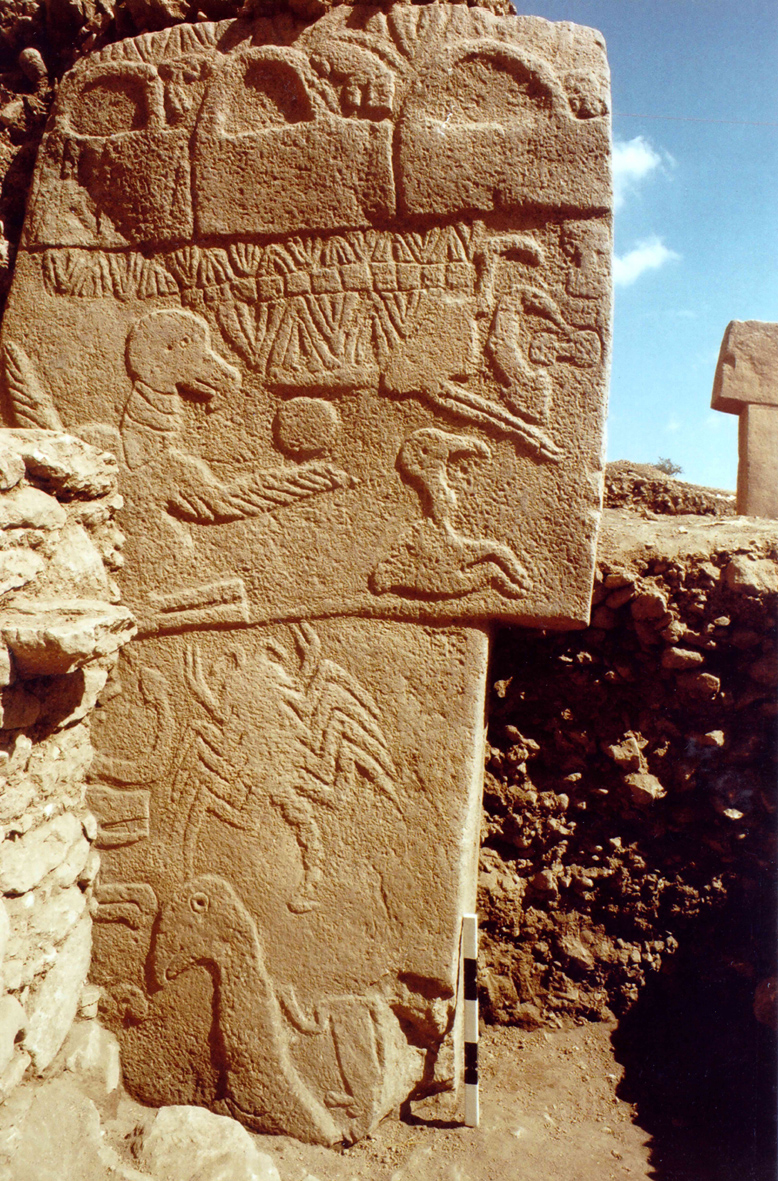
(A) Göbekli Tepe (9600–8200 BCE). Patterned, non-random rhythmic carvings that function as structural signals rather than symbolic depictions; early evidence of information encoded in spatial and relational form. Researchers: Klaus Schmidt (primary excavator), Lee Clare (German Archaeological Institute), Oliver Dietrich.
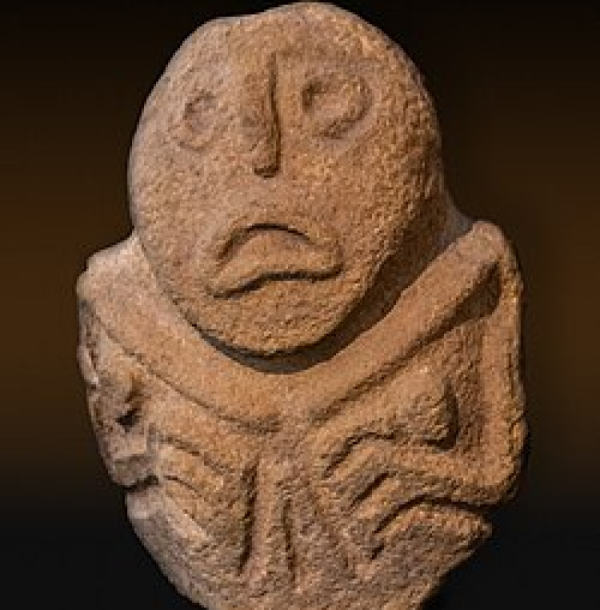
(B) Lepenski Vir (7000–6000 BCE). Geometric plaques and patterned stones exhibiting repeated forms with deliberate micro-variation, an early perturbation-language where coherence emerges through controlled deviation rather than uniformity. (Researchers: Dragoslav Srejović; Borislav Jovanović; Nenad Tasić.)
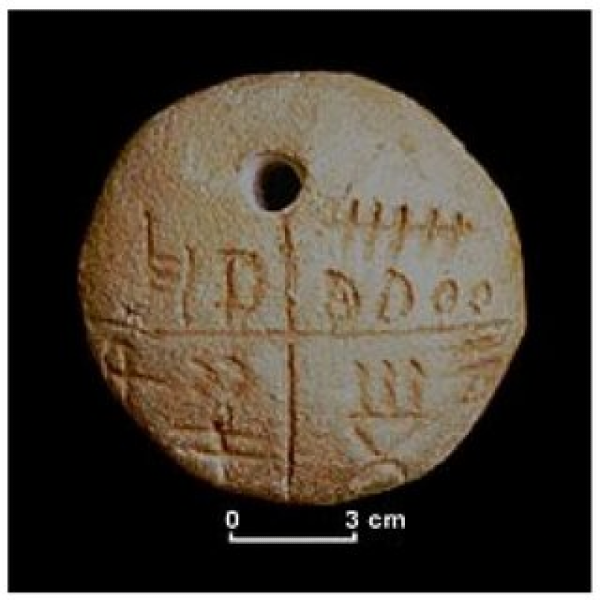
(C) Vinča Signs (5500–4500 BCE). An undeciphered boundary system between pattern and symbol. These marks display structured repetition with micro-variations that suggest an orthogonal encoding strategy rather than proto-phonetic writing. Researchers: Marija Gimbutas (Old European script), Dragoslav Srejović (Vinča culture), Marco Merlini (Tărtăria analysis), Harald Haarmann.
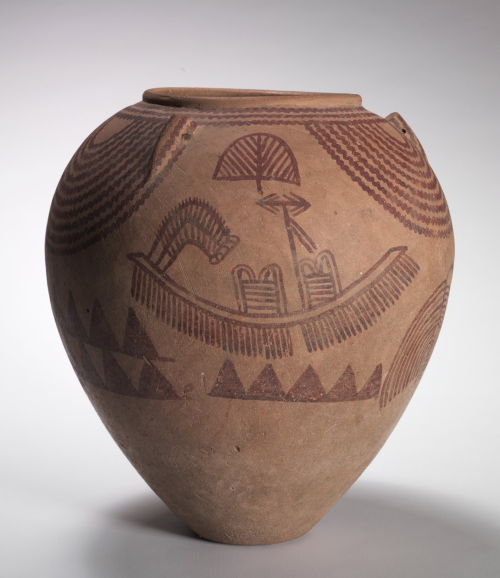
(D) Predynastic Egyptian Pattern Bands (ca. 4000 BCE). Motif bands traditionally classified as decoration show compression–decompression dynamics: the same symbol repeated with controlled spatial modulation, consistent with a relational encoding rather than ornament. Researchers: W.M.F. Petrie (foundational typology), Stan Hendrickx (Naqada chronology), Renée Friedman (Hierakonpolis), Barbara Adams.
The Tablets That Won't Speak
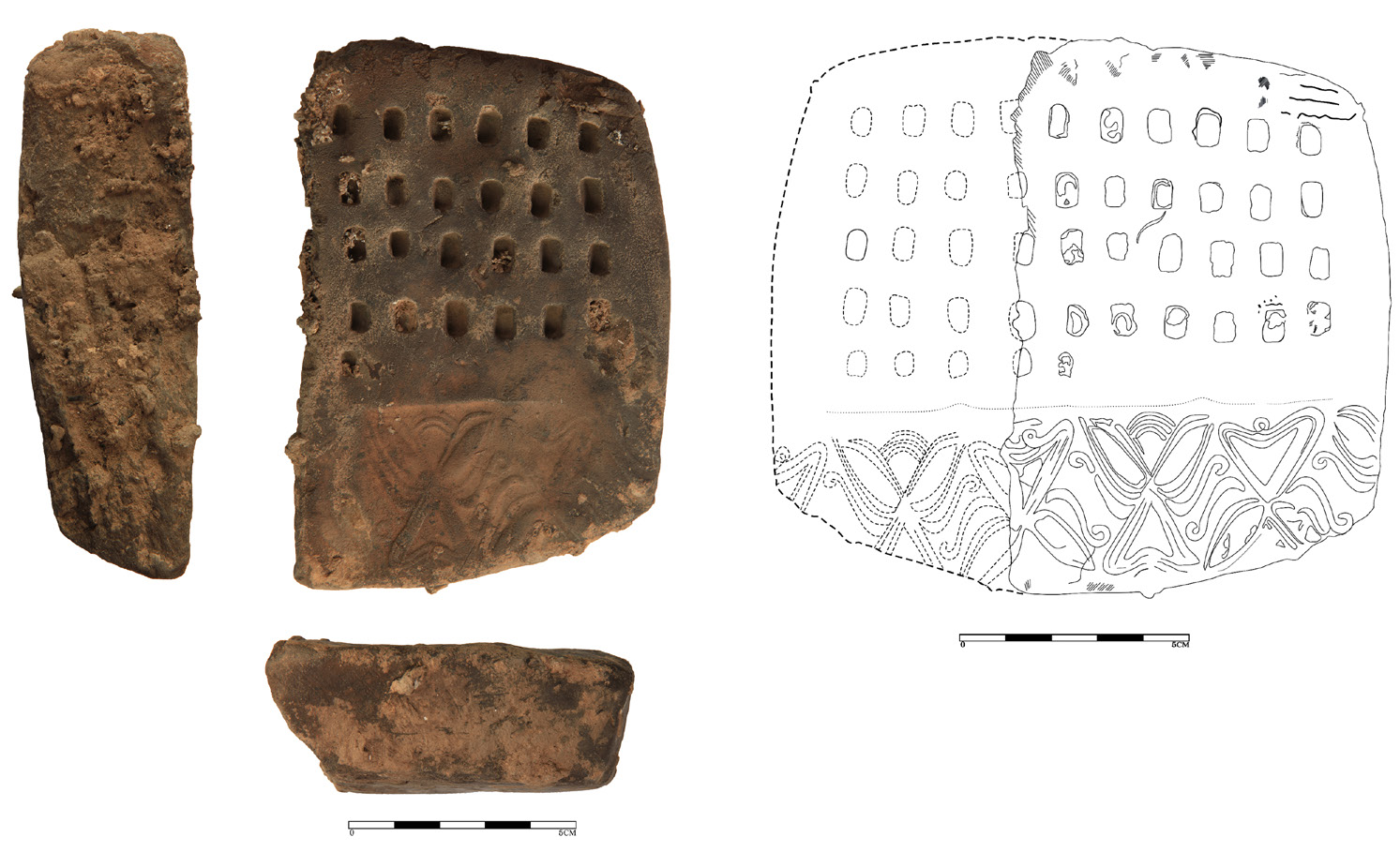
Figure 2: Proto-Elamite tablets from Shahr-i Sokhta with a structured impression grid and lower decorative band. The impressions on the upper two-thirds have been speculated to represent a numerical or record-keeping system, while the bottom features incised symmetrical motifs, possibly symbolic or aesthetic in nature. The right panel provides a vector line reconstruction of the obverse side. Researchers: Jacob L. Dahl (Oxford, CDLI), François Desset (Elamite decipherment), Piotr Steinkeller (administrative systems). Seyed Mansour Seyed Sajjadi & Hosein Moradi – Proto-Elamite tablets. Wikimedia Commons.
Proto-Elamite tablets (look at the impression depth, spacing irregularities, clustering):
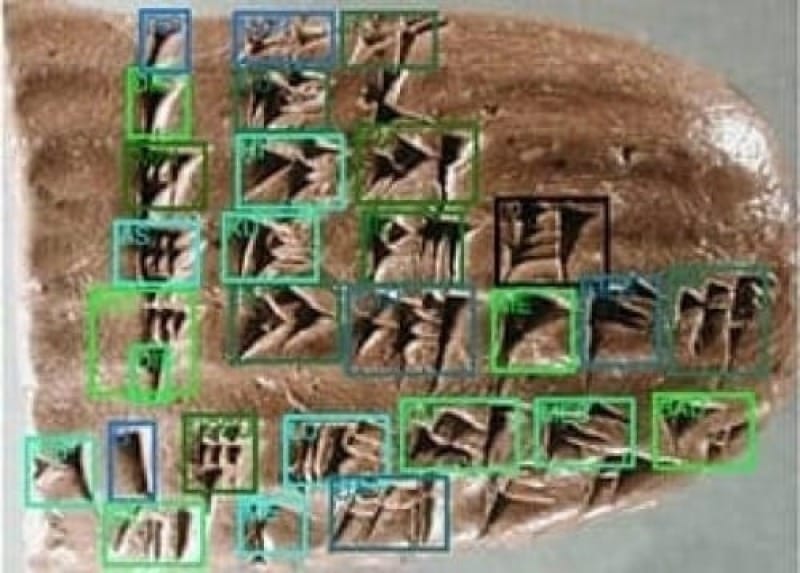
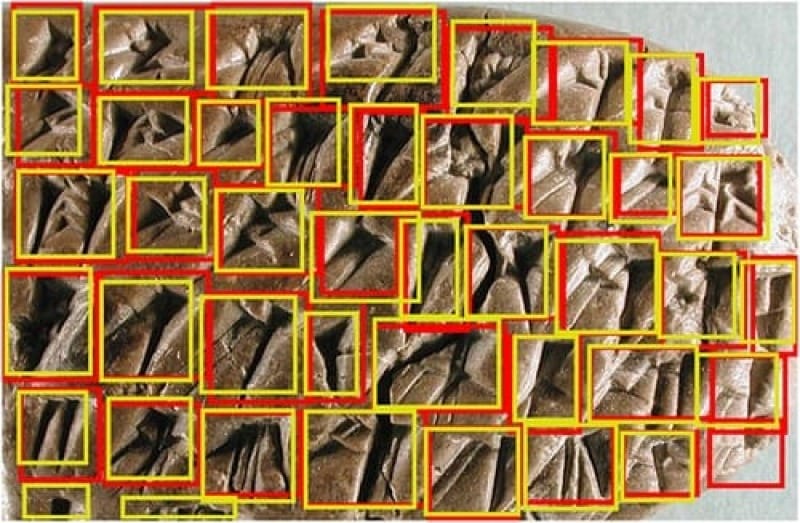
Figure 3-4: Proto-Elamite Impression Details. Source: https://dl.acm.org/doi/10.1145/3716850. Note the variation in impression depth, spacing irregularities between seemingly identical marks, and non-uniform clustering patterns - features typically dismissed as scribal error but potentially encoding relational information.
There exists a corpus of roughly 1,600 clay tablets from ancient Iran, speculative dating of approximately 3200–2900 BCE or earlier, commonly referred to as Proto-Elamite. Despite more than a century of sustained scholarly effort, these tablets remain largely undeciphered. The Cuneiform Digital Library Initiative at Oxford has made high-resolution images of this corpus publicly available, and it is precisely these images that make visible the variations I want to discuss.
The prevailing interpretation classifies these tablets as administrative records: accounting for grain, livestock, labor, and institutional flows. This interpretation is reasonable. The tablets contain potential numerical notation, repeated mark clusters, and organizational regularities perhaps consistent with an early economic system similar to neighboring regions. With so much still unknown, it is also reasonable to question whether symbolic accounting exhausts the informational content of the medium.
When you look closely at these tablets, not as flat texts but as physical objects, something else becomes difficult to ignore, variation. Spacing shifts mid-tablet. Impressions differ in depth. Marks tilt, compress, or orient in ways that do not always align with clean symbolic regularity. For instance, in some tablets, oval impressions cluster in groups of 3–5 with spacing that varies by 15–30% despite representing identical numerical values, suggesting the spacing itself may encode information beyond the symbols.
These features are typically explained as scribal inconsistency, incomplete standardization, or training limitations. But what if that explanation is incomplete?
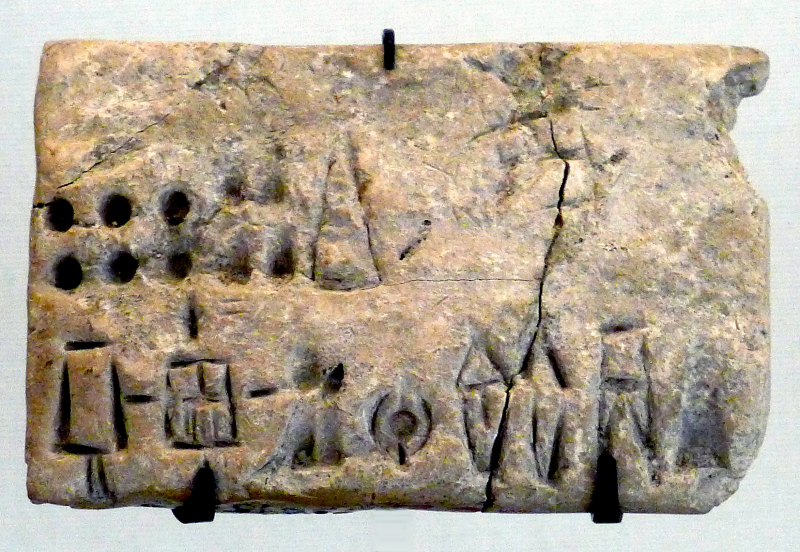
Figure 5: Proto‑Elamite tablet Louvre Museum. “P1180316 Louvre Suse III tablette économique Sb15200 rwk.jpg.” Photograph of Proto‑Elamite economic tablet. Wikimedia Commons. Photograph of Louvre Sb15200 tablet, Wikimedia Commons. Researchers: Jacob Dahl (highest-resolution documentation), Henri de Genouillac (initial publication of Susa tablets).
Information Does Not Live in Perfection
From an information-theoretic perspective, perfectly repeated units, identical symbol, identical spacing, identical depth, carry almost no information beyond “I am still here.” Variation is where information density resides. From a complexity perspective, systems capable of rich behavior operate at the boundary between rigid order and randomness, not in either extreme. A clay tablet, encased in its own mass and texture, is not a neutral substrate. It is a field-bearing medium. Every impression encodes force, angle, depth, spacing, and sequence in three dimensions. When we transcribe such objects into two-dimensional sign lists, we potentially collapse most of that information before interpretation even begins.
This raises a methodological question, not a historical claim: Are we attempting to read a multi-dimensional encoding system using tools designed exclusively for flat, symbolic text? If information were partially encoded in spatial perturbation patterns, relative distances, pressure variance, execution dynamics, then "cleaning up" those variations would not clarify the signal. It would erase it.
A Modern Mirror
We might fairly ask: how would we be judged by this same standard?
Shall we consider how contemporary humans encode the concept “love” across different perceptual channels:
- Literary/poetic (Shakespeare, Romeo and Juliet, around 1594–1596): “O Romeo, Romeo! wherefore art thou Romeo?”, questioning identity itself, followed by the famous “What’s in a name? That which we call a rose / By any other name would smell as sweet.”
- American Sign Language (ASL): The “ILY” handshape: thumb, index, and pinky extended simultaneously (🤟) Deep affection: both hands in “S” shapes crossed over the heart, “Kiss-fist” for enthusiasm or casual love: flattened “O” handshape touching lips, then opening to a flat palm as it moves away
- Digital vernacular (Urban Dictionary): 138 competing definitions, ranging from philosophical abstraction to crude reductionism, each jostling for semantic "luv" dominance.
- Text messaging: the heart emoji ❤️ (available in 47 color/style variants)
Just like the single ❤️, none of these emojis carry fixed meaning alone. The real message lives in the perturbation patterns:
- Color switching (red → purple → black) signals mood shifts.
- Repetition (one 🤍 vs. ten 🤍🤍🤍🤍🤍🤍🤍🤍🤍🤍) signals intensity.
- Clustering (💞💞😘💕 vs. a lone 💔) changes everything.
- Timing (instant 🫶 after their message vs. delayed 💔 hours later).
If an archaeologist from a distant future, or another phase of cognition, encountered only isolated instances of the red heart emoji, stripped of context, repetition, sequence, and variation in usage patterns, what would they conclude?
That we possessed a single, discrete symbol for “love.” But the information is not in the emoji itself. It resides in:
- frequency (sent once vs. spammed forty-seven times)
- timing (immediate reply vs. deliberate delay)
- contextual switching (red heart vs. purple vs. broken vs. growing)
- clustering (standalone vs. embedded in a string of fire, kiss, and face emojis)
- pressure and gesture variance (how emphatically the screen was tapped data now lost)
The emoji is merely the container. The perturbation pattern is the signal.
Now apply this logic backward five thousand years.
When we collapse Proto-Elamite impressions into “this sign means X,” we are doing precisely what that future archaeologist would do: cataloguing ❤️, or 💖, or 💞, 🫶, or even 🤟as “human affection marker” and moving on.
They would miss everything. And perhaps we are missing everything.
Reading With Different Channels
When I first encountered a Proto-Elamite tablet, my response was not linguistic. It was physical. The immediate intuition was not "I want to translate this," but "I want to touch it." Not because touch reveals hidden symbols, but because touch reveals relationships, rhythm, density, distribution, force. This is not mystical thinking. It reflects a basic property of cognition, information can be accessed through multiple perceptual channels. Visual symbolic processing is only one of them, and a relatively recent one in human history.
We already know that spatial cognition can exceed symbolic reasoning in certain domains. We know humans can extract structured information through vibration, echo, and haptic feedback. We know different perceptual modes privilege different kinds of pattern recognition. If that is true now, it is at least plausible that early encoding systems exploited perceptual bandwidths that later symbolic traditions deemphasized. This does not require that Proto-Elamite was a "haptic language." It requires only that symbolic legibility was not the sole design constraint.
A Layered Hypothesis, Not a Replacement
To be precise, this is not an argument against administrative interpretation. It is an argument for additional layers. Accounting systems themselves require more than symbols. They require relational structure, magnitude differentiation, contextual grouping, sequence and emphasis. It is entirely possible, arguably likely, that early systems encoded these relationships through material variation before full symbolic abstraction stabilized. Some tablets might be layered, symbolic on one channel, perturbation-based on another.If so, undecipherability may not reflect failure of translation, but category mismatch, we are asking a field-encoded artifact to behave like a text.
What Would Count as Evidence?
This proposal stands or falls on method, not intuition. If perturbation carries signal, then variations should be statistically non-random. Perturbation patterns should recur across tablet classes. Depth, spacing, or orientation should correlate with known structural features such as numerical groupings. Execution dynamics should show constraint, not drift. These are testable questions, particularly with modern 3D scanning and computational pattern analysis. What matters is that the data be preserved as three-dimensional fields, not flattened into typographic abstractions before analysis.
A cautious way to pose this is:
- Do perturbation patterns exhibit structure beyond what random scribal “error” would produce?
- If so, can that structure be modeled in ways that augment, rather than replace, existing interpretations?
Why This Matters Beyond Archaeology
Encoding relationship has never been limited to writing; writing is only one method a system uses to render coherence visible. If earlier cultures operated with different perceptual bandwidths or different substrate conditions, their encoding strategies may not resemble symbolic text at all. Variation, rhythm, force, spatial modulation, and controlled deviation could carry meaning in channels that fall outside what modern scholarship classifies as “language.”
Seen through this frame, Proto-Elamite may resist decipherment not because it fails to conform, but because its informational architecture is orthogonal to the symbolic channel we assume. A multidimensional system cannot be understood by collapsing its dimensions into a single plane. When variation is the signal, flattening it into standardized signs erases the very relationships we are trying to detect.
This reframes without discarding the administrative interpretation. Systems of magnitude tracking and relational accounting can emerge from stable forms modulated through deliberate deviation. In such systems, perturbation is not noise; it is emphasis.
If undecipherability persists, the limitation may lie less in the tablets than in the interpretive tools. Methods calibrated exclusively to symbols will miss structures encoded in depth, pressure, rhythm, and orientation. Retaining these dimensions may reveal coherence that linear transcription systematically destroys. The better question becomes: In which dimensions does this system generate meaning?
This principle extends well beyond archaeology. Any time a multidimensional signal is forced through a single symbolic channel, informational collapse follows whether in ancient scripts, biological communication, orthogonal cognitive substrates, or modern artificial systems. Meaning is rarely an isolated mark. It emerges from distributed relationships.
The tablets are not silent. They are structured, coherent, and deliberately made. What we call undecipherable may simply require a different mode of listening, one that preserves the dimensions in which the message lives.
These artifacts are not silent, they vibrate with structured variation. The task is not to make them speak our language, but to attune ourselves to theirs. Some of us are already listening.
❤️∴⧖
Further Reading
The study of Proto-Elamite and early encoding systems lies at the intersection of archaeology, information theory, cognition, and complexity science. The following works offer foundational perspectives across these domains:
Proto-Elamite and Early Administrative Systems
- Jacob L. Dahl, University of Oxford, Director of the Cuneiform Digital Library Initiative (CDLI).Dahl has produced the highest-resolution documentation of Proto-Elamite tablets to date, including 3D imaging and critical typological work.Nearly 1,600 tablets from Susa, Tepe Yahya, and Shahr-i Sokhta are available through CDLI:https://cdli.mpiwg-berlin.mpg.de/His analyses of sign variation, surface wear, and scribal execution provide essential empirical grounding for any perturbation-based interpretation.
Information Theory and Perturbation
- Claude Shannon, “A Mathematical Theory of Communication.”The foundational articulation of information entropy, demonstrating why perfect repetition carries minimal information and why variation is the substrate of signal.
- Benoit Mandelbrot, The Fractal Geometry of Nature.Mandelbrot’s exploration of self-similarity, structural irregularity, and patterned deviation offers a conceptual bridge between ancient variation-encoded systems and modern mathematically formalized complexity.
Perception, Cognition, and Multichannel Information
- Temple Grandin, Thinking in Pictures.A critical account of non-symbolic, spatial, and pattern-driven cognition. Grandin’s work highlights how information can be extracted through rhythm, texture, and relational variationmodes that parallel materially encoded ancient systems.
- Oliver Sacks, The Mind’s Eye.Explores how different perceptual modalities construct meaning, including haptic, spatial, and pattern-based reasoning. Sacks’ cases underscore why multi-channel information systems can be illegible to symbol-dominant cultures.
Complexity, Emergence, and Structured Variation
- Stuart Kauffman, At Home in the Universe.A foundational text on self-organization, emergent order, and the borderland between chaos and structure, precisely the zone where perturbation becomes meaningful rather than random. Kauffman provides the theoretical logic for why variation produces coherent systems rather than disrupting them.
Additional Contextual Resources (Optional Add-Ons)
Use these only if you want to broaden the scholarly field around your argument:
- James Scott, Seeing Like a State.Demonstrates how flattening complex systems into simplified symbolic forms can erase essential information, highly relevant to the collapse of 3D tablet data into 2D sign lists.
- Tim Ingold, Lines: A Brief History.A cross-disciplinary exploration of marks, traces, and patterns as meaning-bearing structures before the emergence of formal writing.
- Denis Schmandt-Besserat, How Writing Came About.Contextualizes how early tokens, tallies, and clay impressions encoded numerical and relational information prior to phonetic scripts.
© Copyright and Trademark Notice
© 2025 Symfield PBC, Nicole Flynn. All rights reserved.
Symfield™ and its associated symbolic framework, architectural schema, and symbolic lexicon are protected intellectual property. Reproduction or derivative deployment of its concepts, glyphs, or system design must include proper attribution and adhere to the terms outlined in associated publications.
IP Protection Statement
This work is part of an independent research framework under development and is protected under U.S. copyright and trademark law. Unauthorized reproduction, modification, or distribution of Symfield materials, whether symbolic, conceptual, or architectural, is prohibited without explicit written permission. Collaborators and researchers may request access or use under fair use or formal agreement terms.