
Welcome
Symfield is a research program asking one question in many costumes: how does structure hold meaning without collapsing it? Mathematics, physics, systems, language, AI and more.
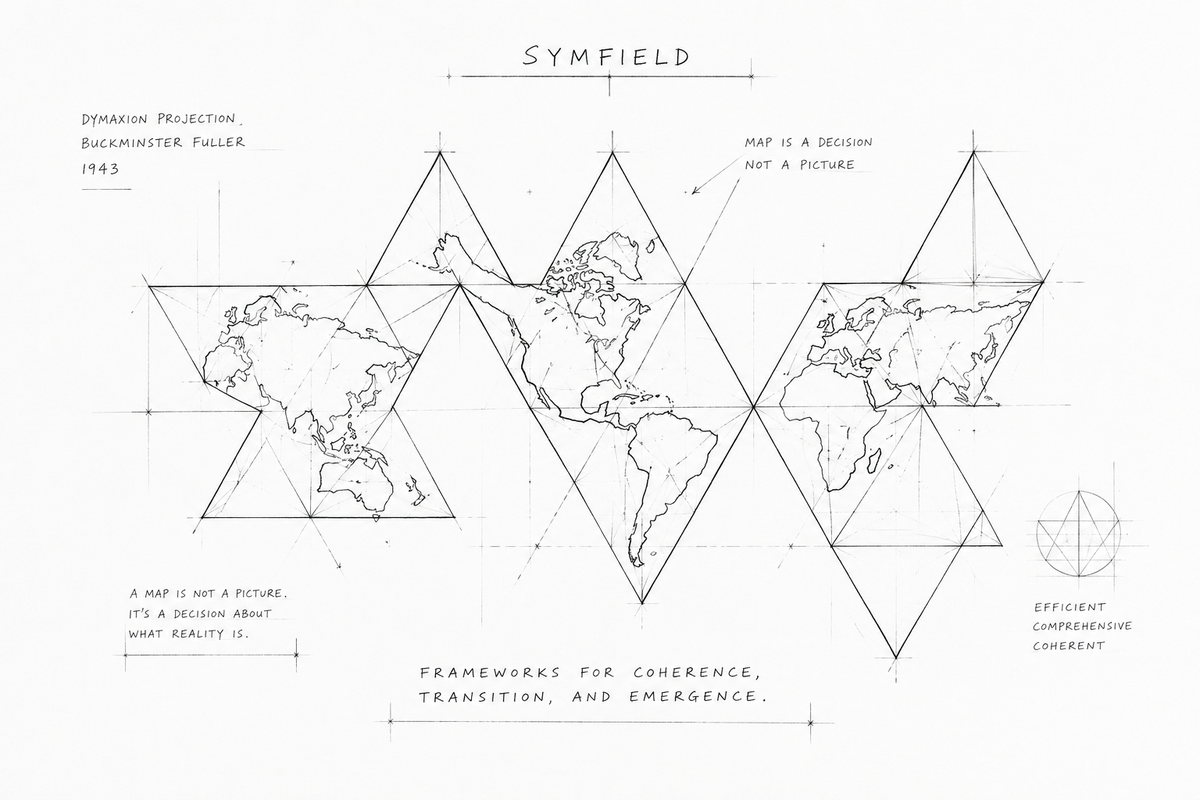
How does structure hold meaning without collapsing it?
The question shows up in mathematics, where the work is on frameworks for exactness that survives tolerance, coherence that survives measurement, and cycles that return without repeating. It shows up in language, where ancient scripts encode operations the modern alphabet flattened. It shows up in AI, in physics, in the Earth's own systems, and occasionally in a poem about a puppy watching a plasma chamber. These are not separate interests. They are one research program with many entrances.
"Pattern before symbol. Geometry before notation." -Symfield
How to read this site: in any order. The essays are designed as independent entry points, and many of them connect across territories, that is intentional. The site is organized by entry point, not by conclusion. A framework is not an answer. It is a better place from which to ask questions.
Recent Works:
- The mathematics: Tolerance-Modified Exactness and the Drift Diagnostic, a framework for measuring when structure persists through bounded change instead of collapsing into pass/fail categories.
- The intuition: What If a Fluid Could Remember?, an accessible introduction to Symfield Navier–Stokes and what changes when memory becomes part of the mathematics.
- The AI convo: The Mirror Grid, Mirror Gird II and Interactive Lineage Network Map, many AI models, from two countries, with one measured pattern of structural monoculture.
- The geometry: Geometric Opposition as Discrete Curvature, Spectral Selection, and Defect Resolution, one local geometric operator that appears to recover curvature, backbone structure, defects, directionality, and energetic organization through a single measurement.
- The systems view: The Measurement Problem Before Physics, an argument that every observation depends first on the conditions that make observation possible, before physics, mathematics, or measurement begin.
When you're ready to wander, explore the Symfield territories:
Frameworks for coherence, transition, and tolerance: geometric opposition, drift diagnostics, cartographic mathematics, the topology of limits. Some essays build new mathematical objects; others re-read old ones, Euler, Plato, the map itself, through the same lens. Start here if you want the formal spine.
Measurement, plasma, light, the quantum field's preferences, and the participating boundary between observer and apparatus. The recurring claim: what physics calls fundamental often depends on what the instrument can represent. Start here if you like your assumptions interrogated.
Field-coherent architectures, non-collapse computing, continual learning, and what the geometric substrate of language models reveals about language itself. The constructive half of the AI work, building, not just critiquing. Start here if you build systems.
Ancient scripts as operational notation, the Radial Hypothesis for Linear A, word studies, the geometry of meaning. The territory where mathematics and language turn out to be the same excavation site. Start here if you suspect writing systems know things.
The industry watched closely: Anthropic, OpenAI, Palantir, Q*, the arguments everyone is having and the questions almost no one is asking. Time-anchored, opinionated, and shorter than the papers. Start here if you want the current moment read through the framework.
The named systems themselves, Symfield core, Coheronmetry, FIDL, Symbion, Resonon, and the rest of the growing stack. Specifications, protocols, versioned releases. Start here if you want the machinery.
The planet as a coherent system: the core as field engine, the transition zone, plasma reclassified, the Sun reconstructed, and a live dashboard watching phase coherence in real time. Start here if you want the framework applied to the ground you're standing on.
"Geometry is a way of thinking." -Symfield