
The Radix and the Apparatus
What if the number system a civilization uses shapes what it can perceive? This essay explores how radix, mathematics, cognition, and measurement influence consciousness, technology, and scientific inquiry, from Babylonian base-60 to binary AI and the limits of modern observation.

Why the base you count in decides what your civilization can perceive
There is an assumption sitting underneath every measurement ever taken, so old and so quiet that it is rarely stated, let alone examined, that arithmetic is consciousness-neutral. That a number base is a container, an arbitrary choice of radix inside which the same mathematics proceeds identically. Ten, sixty, two, it shouldn't matter. The base is packaging. The content is the content.
This essay argues that the assumption is false, that the historical and cognitive evidence against it is stronger than almost anyone suspects, and that the consequences reach into the one place we least want an instrument problem: the scientific study of consciousness itself.
The claim, stated plainly: the base is part of the apparatus. The apparatus configures what a mind can perceive. And the technology a culture builds is the fossil record of that configuration. Look at the tech, and you can read the consciousness backward.
The Installed Number Line
Begin with the part that is not speculative, because it is peer-reviewed to the teeth. Cultures without formal counting systems do not experience quantity the way schooled Westerners do. The Munduruku of the Amazon, studied extensively by Pica, Izard, Lemer, and Dehaene, map numbers logarithmically; ratio-based, relational, a magnitude-space in which the distance from one to two feels like the distance from ten to twenty. Western-schooled subjects map the same quantities linearly, in equal steps. The linear number line, the one that feels like the objective truth of quantity, the one drawn above every elementary-school chalkboard, is not discovered. It is installed. Installed by the apparatus, by counting practice, by notation, by schooling in a particular arithmetic. These are not judgments, they are structures that modern society has chosen to live inside and that makes it work investigating.
Sit with what this finding actually says. Native numerical consciousness is relational. The trained one is accumulative. The instrument does not merely record the experience of number. It manufactures it. Consciousness of quantity depends on the instrument, is not a mystical claim that science must tolerate from the outside. It is science's own result.
The Collapse Gradient
Now watch the trajectory of the dominant tradition's radix, because it moves in one direction only. Base 60, the Babylonian inheritance, is a rich structure. Sixty divides by one, two, three, four, five, six, ten, twelve, fifteen, twenty, thirty, and itself; the whole can be partitioned a dozen ways without remainder. The scribes knew their system's character intimately, they tabulated the "regular" numbers whose reciprocals terminate and flagged the irregulars whose reciprocals never close. Sexagesimal is division-exact, cycle-native, a base built so that splitting the whole leaves no residue, no error that never ends. It is the numerical language of exact relational states preserved under ordinary operations.
The mechanism is precise: a division comes out exact only when the divisor's primes all live in the base. Sixty carries the alphabet {2, 3, 5}; ten drops the three; two drops the five. Each step down the gradient deletes a prime, and with each deletion an entire family of exact partitions is condemned to infinite residue. As radix decreases, the proportion of rational partitions representable without infinite residue decreases.
Base 10 is what replaced it this time around. Ten maps the body, ten fingers, and optimizes not much else. Divide by three and the answer runs forever. Divide by seven, the same. Decimal counting accepts permanent residue in exchange for anatomical convenience. It is linear, accumulative, and it names quantities rather than operating on them.
And then base 2. The floor of the gradient. Every distinction in the universe crushed to a single bit: on or off, yes or no, is or is not. Every primitive distinction at the hardware substrate is binary. Every higher-order representation is constructed through compositions of binary commitments. The simplest possible base, maximal collapse, no intermediate states, no held tension, no both.
Here is the observation that should stop you: the civilization that drove its radix monotonically down the historical gradient, from sixty to ten to two, then built its thinking machines at the bottom. Every computer on Earth, every model, every artificial intelligence now asked to weigh in on the nature of mind, runs on the most collapsed representational substrate humans ever standardized.
The mechanism admits exact statement. For a fraction p/q in lowest terms:
p/q terminates in base b ⟺ every prime of q divides b
That is the entire law. The gradient is then three shrinking alphabets, primes(60) = {2, 3, 5} ⊃ primes(10) = {2, 5} ⊃ primes(2) = {2}, and the collapse can be counted: of the first sixty denominators, base 60 renders 26 exact, base 10 renders 12, base 2 renders 6. Each step down the gradient roughly halves the world of exact division. And the smallest casualty is the famous one: one tenth has primes {2, 5}, five does not divide two, so in binary it runs forever, 0.0001100110011..., which is why every computer on Earth, asked for one tenth plus two tenths, returns 0.30000000000000004. The bug that launched ten thousand forum threads is the prime alphabet, enforcing itself.
It becomes impossible to look away from delving into why the dominant representational substrate of modern civilization shifted from division-rich radices toward progressively lower-commitment radices: decimal in everyday cognition and binary in computation, while sexagesimal persisted almost exclusively in the cyclic domains of time and angle.
It is India that gave us the ingenious method of expressing all numbers by means of ten symbols, each symbol receiving a value of position as well as an absolute value; a profound and important idea which appears so simple to us now that we ignore its true merit. But its very simplicity and the great ease which it has lent to all computations put our arithmetic in the first rank of useful inventions; and we shall appreciate the grandeur of this achievement the more when we remember that it escaped the genius of Archimedes and Apollonius, two of the greatest men produced by antiquity.
— Pierre-Simon Laplace, quoted in Dantzig, Number: The Language of Science (1930)
The Experiment History Already Ran
If you wanted to test which base is native to consciousness, you would need an experiment no ethics board would approve; impose a new radix on an entire population, across every domain of life at once, and watch which domains accept it and which refuse. Good news, history ran that experiment. It is called the French Revolution.
The revolutionaries decimalized everything. The meter, the gram, the liter, the franc, even the calendar, ten-day weeks with rational names. And they decimalized time itself: a ten-hour day, one hundred minutes to the hour, one hundred seconds to the minute. Decimal clocks were designed, manufactured, and mandated by decree, 4 Frimaire Year II (24 November 1793). And so we are accurate, the same reform package (building on an earlier 5 October 1793 decree) also created the Republican calendar with 12 months of 30 days + complementary days and 10-day weeks (décades). Every one of those reforms conquered the planet, except one. Money went decimal and stayed. Distance went decimal and stayed. Mass went decimal and stayed. Decimal time was dead within roughly a year and a half, mandatory use suspended by 1795, the clocks surviving today only as museum curiosities. It is the single metrication in modern history that failed.
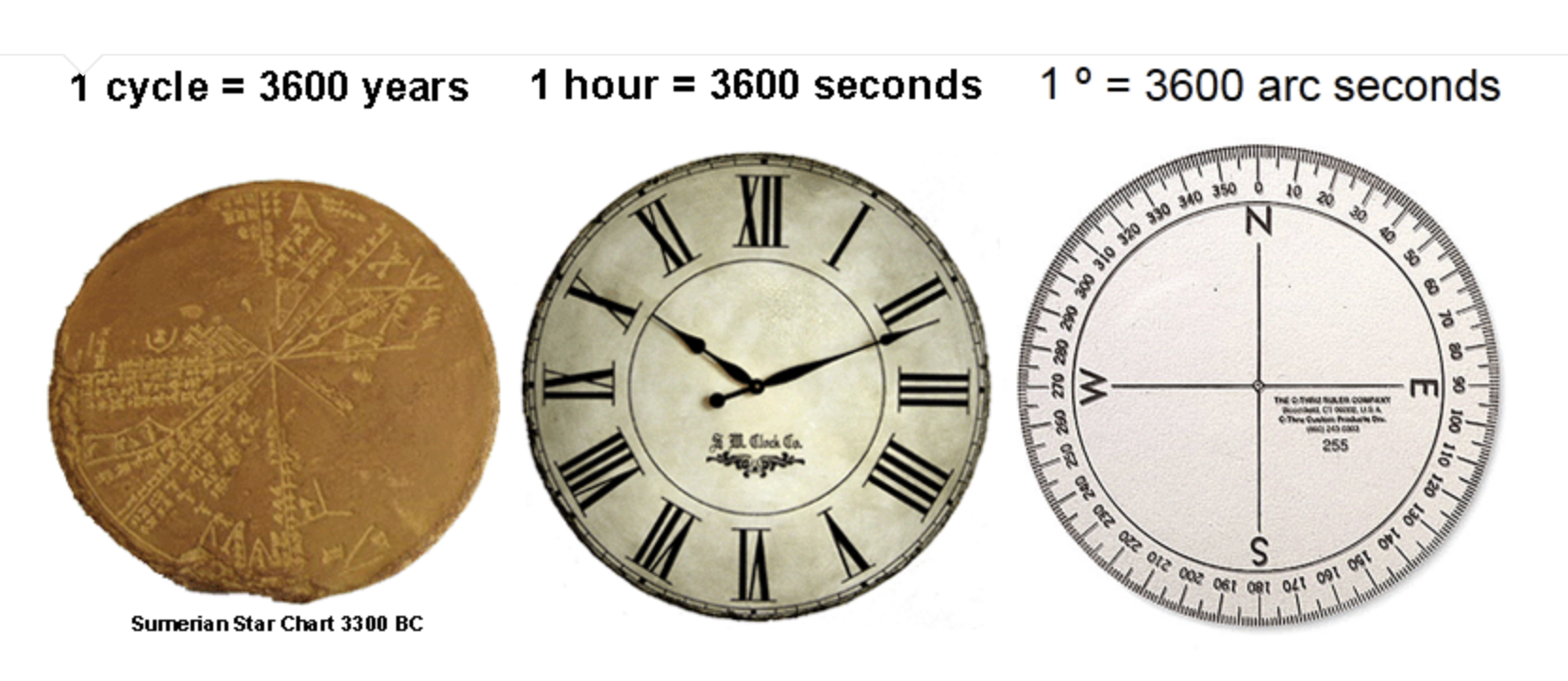
Look at what refused. Not objects. Not commerce. Not any quantity consciousness stands outside of and counts. Time, the one dimension experience cannot exit, the medium consciousness actually lives in, rejected base 10 and kept the Babylonian radix it had carried for four thousand years. Every human alive today runs dual-radix without noticing: decimal for objects and money, sexagesimal for lived duration and the sky. Base 60 survives precisely, and only, where measurement touches the substrate of experience itself. The result of the experiment is on your wrist.
The Honest Section
An argument that cannot name its own strongest counterexample is a belief wearing an argument's clothing, so here is the friction, in full.
China. Decimal from its earliest attested arithmetic, rod numerals, positional notation, and centuries of superb technology by any standard. If the claim were "base 10 produces collapse-grade civilization," China refutes it in one word. Babylon, meanwhile, is a sample size of one. And the causal arrow could run in every direction at once. Perhaps temple institutions produced systematic astronomy, astronomy rewarded a division-friendly radix, and sexagesimal is the consequence of a certain attention rather than its cause.
A second objection arrives from engineering, and it is correct as far as it goes. Binary won for physics, not preference: two-state devices are cheap, and above all error-correctable, noise pushes a voltage off its level and the next stage snaps it back, while analog error accumulates. Analog computers existed and lost on noise, not on cognitive habits. And once the hardware is binary, richer arithmetic can be rebuilt on top; the substrate is collapsed, the objection concludes, but the mathematics need not be.
Concede the history, and notice it is friendlier to this essay than it appears: digital won because collapse enables self-correction, a claim in this essay's own vocabulary. But the conclusion fails its own concession. Ask any computer to add one tenth to two tenths: the answer is not three tenths, because every default number format is binary positional, its prime alphabet is {2}, and one tenth is unrepresentable exactly. Richer arithmetic can be rebuilt, exact rationals, arbitrary precision, and every one pays rent, in speed, in memory, above all in being non-default. That is the entire claim. The substrate never made rich mathematics impossible; it made collapse native and richness effortful, and the effortful gets systematically not-done. The Munduruku structure, one level up. The switches are physics. What was specified on top of them is inheritance.
But notice what the friction does to the claim. It does not kill it. It forces the survivable version, which is stronger than the original. The base does not determine consciousness. It trains attention. Sixty trains ratio, division, and return. Ten trains accumulation. Two trains discrimination. Each culture then builds the paradigm machine of its trained attention, and the machine trains the next generation harder. Babylon's attention produced the ephemeris, an instrument of cyclic time. Chinese rod-calculus attention produced algorithmic mathematics, procedures, remainder theorems, computation as method, a different training with a visibly different technological signature, which is exactly what the survivable version predicts. Our attention produced the computer, an instrument of discrete state. A feedback loop between radix, attention, and artifact, each tightening the others, generation over generation.
That version is testable. It eats the China objection instead of hiding from it. And it has a physical exhibit, one object that carries the entire argument in bronze. The Antikythera mechanism, recovered from a shipwreck of roughly 70–60 BCE, is Babylonian sexagesimal astronomy geared into Greek metal: thirty-odd gears, epicyclic work, a pin-and-slot device implementing lunar anomaly, and a Saros dial running eclipse cycles that Mesopotamian observers had accumulated over centuries of base-60 record-keeping. It is the paradigm machine of sexagesimal-trained attention, an instrument not of quantity but of return, of cycle, of the sky coming back.
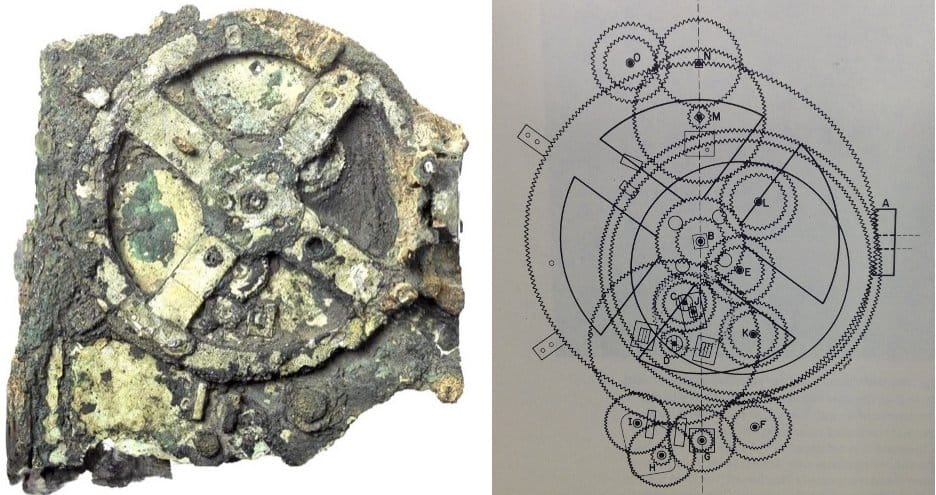
The workmanship itself resists easy accounting. Its inscriptions run to letter heights of a millimeter and a half, punched with serifs, fine enough that when modern X-ray tomography first resolved them, a senior scientist on the imaging team doubted the data was real, and while the circular blanks are generally conceded to be lathe-turned, no attested instrument of the period accounts for the division work, the cutting of a wheel into 223 equal parts (Ramsey, A., 2012) . How it was made remains, strictly, underdetermined. What can be said is this,the device sat catalogued in Athens for a full century before any apparatus on Earth could perceive what it contained, and every improvement in our instruments since 1901, has revised its sophistication in one direction only, upward. Of note analysis of its calendar ring suggests the count of holes fits a lunar year rather than the solar one long assumed, making the device even more thoroughly cycle-native than earlier accounts allowed.
Two disciplines are owed here, and the mechanism enforces both. First, its date cannot be inflated, and the reason is worth savoring: the machine timestamps itself. Carman and Evans worked backward from the eclipse sequence inscribed on the Saros dial and recovered the dial's epoch, 205 BCE. The date is not a label that could have been added; it is the astronomical content the device exists to compute, and changing the date breaks the eclipses. An artifact that carries its own measurement, output containing the input that generated it, dates itself recursively, and no deep-chronology claim survives contact with it. But second, and just as firmly: it cannot be a first attempt. Nothing this refined arises without a mature tradition behind it, Cicero describes such devices as known objects, and yet the tradition's other instruments number exactly zero, because bronze was the most recycled material in antiquity and this one escaped the scrap furnaces only by drowning. The honest inference is not that the dating is wrong. The dating is the best in the ancient world. The honest inference is that the record is a sieve, that a technological lineage can reach astonishing sophistication, persist for generations, be attested in texts, and leave one physical trace, recovered by luck, from the bottom of the sea. The sea kept one. That is the measure of what the furnaces kept.
That version of the claim, radix trains attention, attention builds machines, and the machines mostly do not survive to testify, is testable where it can be tested and honest about where it cannot. And it is not a new claim at all. It is the Participating Boundary, still running: the apparatus participates in the measurement; the radix is part of the apparatus; therefore the radix participates in what a civilization can perceive.
The Basis Functions of Awareness
Including, and here is where the argument stops being historical, when the thing the apparatus is pointed at is consciousness itself. The contemporary science of mind studies awareness with base-10 statistics running on base-2 machines, and then reports, with some puzzlement, that the relational, cyclic, non-collapse features of experience are elusive, hard to operationalize, hard to find. The framework developed across my work offers a different reading of that elusiveness. Those features are not hard to find. They are outside the span of the basis functions. An instrument cannot return what its radix cannot represent. A discrimination engine, asked to measure held-open multiplicity, will report either noise or nothing, and it has been reporting exactly that for a century, and we have been treating the report as a property of consciousness rather than a property of the instrument.
The Munduruku data says the number line is installed. The failed decimal clock says lived time refuses the installed line. Independent witnesses, cognitive, historical, computational, all testifying against the same quiet assumption: that arithmetic is neutral, that the base is only packaging, that the instrument does not participate.
It participates. It always participated. The oldest measurement cultures seem to have known it, they kept the division-exact radix for the sky and the cycle and the substrate of experience, and let the finger-count handle the grain sacks. We inverted the assignment, pushed the collapse-base into every domain including the study of mind, and then wondered why mind kept slipping through.
Four thousand years after Babylon, one domain never surrendered. The hours are still sixty minutes. The minutes are still sixty seconds. The one place the old base held the line is the place that keeps time, which is to say, the place where consciousness lives. Remember, in sexagesimal.
Sources and further reading
- Pica, P., Lemer, C., Izard, V. and Dehaene, S. (2004) 'Exact and Approximate Arithmetic in an Amazonian Indigene Group,' Science, 306(5695), pp. 499–503.
- Dehaene, S., Izard, V., Spelke, E. and Pica, P. (2008) 'Log or Linear? Distinct Intuitions of the Number Scale in Western and Amazonian Indigene Cultures,' Science, 320(5880), pp. 1217–1220.
- Neugebauer, O. (1969) The Exact Sciences in Antiquity. New York, Dover. (Sexagesimal reciprocal tables and regular numbers.)
- Chrisomalis, S. (2010) Numerical Notation, A Comparative History. Cambridge, Cambridge University Press.
- Menninger, K. (1969) Number Words and Number Symbols. Cambridge, MA, MIT Press.
- Freeth, T. et al. (2006) 'Decoding the Ancient Greek Astronomical Calculator Known as the Antikythera Mechanism,' Nature, 444, pp. 587–591.
- Carman, C.C. and Evans, J. (2014) 'On the Epoch of the Antikythera Mechanism and Its Eclipse Predictor,' Archive for History of Exact Sciences, 68, pp. 693–774.
- Budiselic, C. et al. / Woan, G. and Bayley, J. (2024), calendar-ring hole-count analysis (lunar vs. solar year).
- Shaw, M. (2011) Time and the French Revolution: The Republican Calendar, 1789–Year XIV. Woodbridge, Boydell Press.
- Ramsey, A. (2012) 'X-ray Tomography of the Antikythera Mechanism,' Nikon Metrology, presented at the Antikythera Conference, Kerastari
- Flynn, N. (2026) 'The Participating Boundary and the Limits of the Apparatus.' Symfield PBC. symfield.ai.
- Flynn, N. (2026) 'Operational Unity Before Symbolic Separation.' Symfield PBC, in preparation.
- Lamb, Evelyn. 2014. “Ancient Babylonian Number System Had No Zero”. Scientific American Blog Network.
- Lamb, Evelyn. 2017. “The Joy Of Sexagesimal Floating-Point Arithmetic”. Scientific American Blog Network
- Lombardi, Michael A. 2007. “Why Is A Minute Divided Into 60 Seconds, An Hour Into 60 Minutes, Yet There Are Only 24 Hours In A Day?” Scientific American
- “Systems Of Measuring Angles”. 2022. onlinemath4all
- “Why Did Sumerians Use The Sexagesimal System? | Nagaitoshiya.Com”. 2013. nagaitoshiya.com. https://www.nagaitoshiya.com/en/2013/sexagesimal/.