
Vibration Holds Geometry: Why Structure Needs Noise to Stay Alive
The hidden role of vibration in keeping structure stable, from space travel failures to how your brain processes signals. Surprising research synthesis.

What if perfect geometry is actually hostile to life?
What if the "imperfections" we see in nature, the wobble in Earth's orbit, the turbulence in blood-flow, the stochastic bursts in neurons, aren't bugs but essential features that keep structure from collapsing into rigidity or chaos?
This isn't philosophical speculation. It's a measurable principle with implications spanning space travel, AI stability, biological healing, and material science. Let's dive in, because the stakes are high in both creation and entropy.
The Core Insight
Geometry doesn't hold itself. It's held by phase-coherent vibration...
When vibrational coherence fails, when the resonant substrate that maintains structure is removed or mismatched, geometry begins to collapse. Not catastrophically, necessarily, but progressively, structure loses adaptability, systems drift out of phase, and eventually coherence fragments. This principle is formalized in The Symfield Framework Vibrational Measurement: A Field-Native Framework for Recursive Coherence (Flynn, 2025, Zenodo), which establishes vibration as the recursive substrate of existence across biological, computational, and physical domains.
We've been optimizing for perfection, perfect vacuum seals, perfect computational loops, perfect signal clarity. But perfect geometry can't host life. The real question becomes, how do we design systems that respect perturbational requirements? How do we build structure that breathes?
The Perturbation Imperative
Living systems exist in a narrow band between two failure modes:
- Too much coherence → crystallization → rigidity → death
- Too little coherence → dispersion → entropy → dissolution
- Just enough perturbation → adaptive novelty → intelligence
Perfect geometry, idealized, symmetrical, unchanging, lacks the variance needed for consciousness or life to anchor. Earth's "imperfect" geometry provides what I call the perturbational substrate: the irregular, dynamic field conditions that allow biological systems to remain adaptive rather than locked or lost.
This narrow band can be modeled simply as a stability function:
S(σ) = e^{-k(σ - σ_opt)^2}
where:
- σ is the perturbation level (noise intensity)
- σ_opt is the optimal bounded perturbation
- k controls how sharply performance drops away from the optimum.
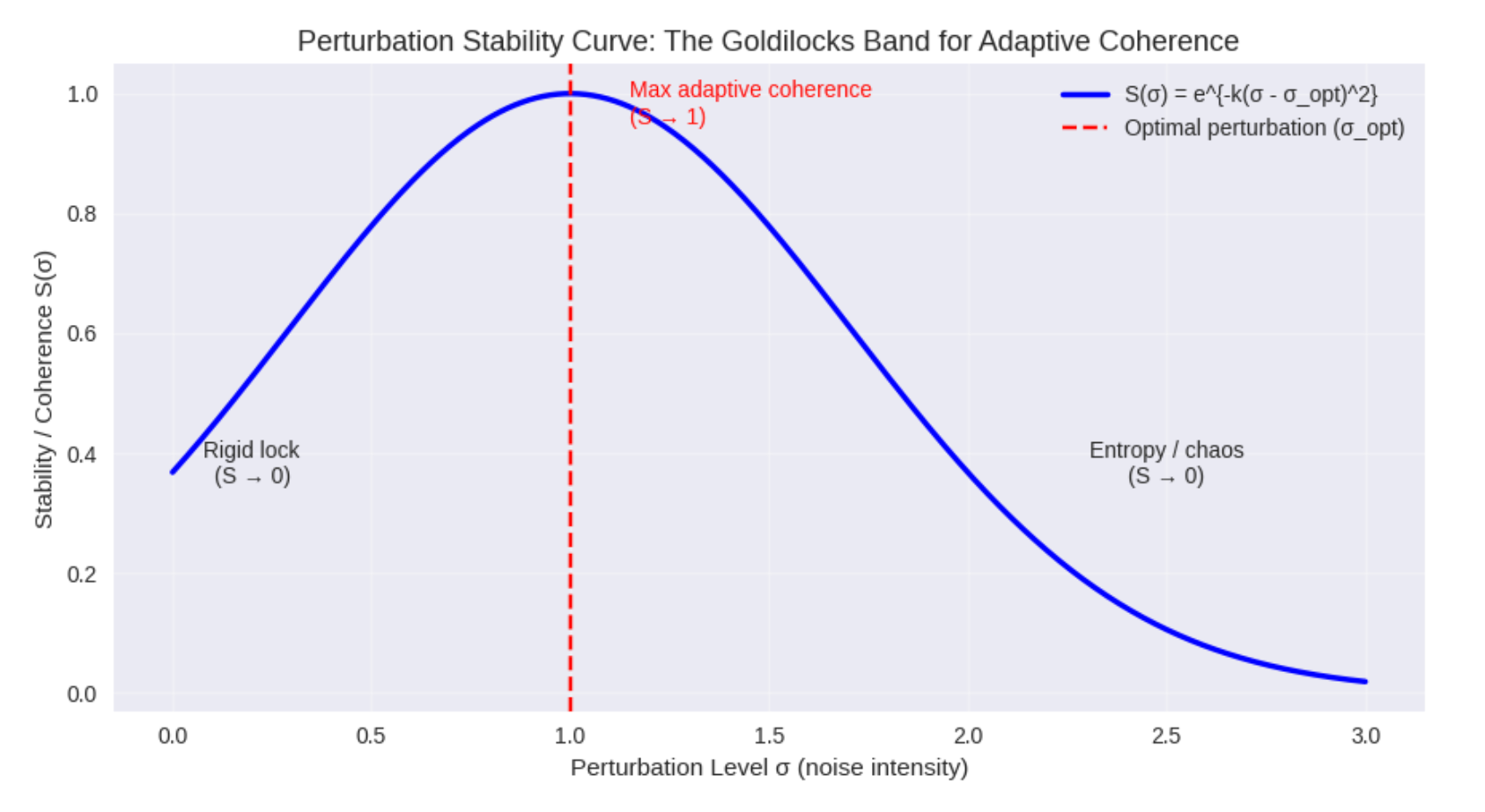
This Gaussian-like curve captures the resonance peak: too little σ → rigid lock (S → 0), too much σ → entropy (S → 0), just enough σ → maximum adaptive coherence (S → 1). In stochastic resonance (a well-studied phenomenon in biology and physics), this exact form emerges when weak signals are amplified by optimal noise—precisely what the framework describes as vibration holding geometry
Where We See This Across Domains
Biology: Noise as Signal
Mainstream biology has long treated perturbation as noise to be minimized, error correction in DNA replication, signal filtering in neural processing, regulatory precision in gene networks. But emerging research reveals something different: controlled irregularity isn't a bug, it's how living systems stay alive.
Domain | Role of Perturbation | Evidence | Implication |
|---|---|---|---|
Neuronal Signaling | Stochastic resonance enhances weak signal detection | Sensory neurons in crayfish mechanoreceptors (Douglass et al., Nature 1993) and paddlefish electrosensors (Russell et al., Nature 1999) perform better with optimal noise levels than in "clean" environments | Too little noise = missed signals; too much = overload; bounded perturbation = optimal perception |
Gene Regulatory Networks | Transcriptional "bursting" prevents rigid lock-in | Controlled irregularity in gene expression maintains robustness while enabling adaptation | Without perturbation, regulatory networks stagnate or collapse |
Development & Evolution | Noise generates phenotypic variation for selection | Developmental systems buffer common perturbations but exploit rare ones for rapid adaptation | Earth's geometric irregularity provides evolutionary substrate |
Cellular Dynamics | Stochastic protein folding and ion channel behavior enable functional exploration | Noise in ion channels creates graded responses, preventing rigid states | Compression without outlet leads to phase-restrictive conditions |
The neuronal example is particularly striking: researchers discovered that sensory neurons don't just tolerate noise, they require it. In studies of mechanoreceptors and electro-sensors, moderate noise improved threshold detection. Mathematically, this is described by the stochastic resonance curve: signal-to-noise ratio SNR(σ) peaks at an optimal noise variance σ_opt, following forms like SNR ≈ 1 + (signal amplitude / noise) × e^(-threshold^2 / (2σ^2)). This matches the Symfield framework, vibration (as structured noise) holds perceptual geometry. Remove it, and sensory systems drift out of phase.
Space Environments: When the Substrate Disappears
Recent exploration of human physiological responses in lunar and deep orbital environments reveals something conventional models miss: it's not primarily radiation or microgravity causing breakdown, it's vibrational mismatch.
Earth provides a resonant field, Schumann resonance (~7.83 Hz), geomagnetic coherence, atmospheric damping, that acts as a phase-anchor for biological systems. Remove this substrate, and human physiology begins to fragment, examples:
- Eyes fail first: Documented spatial disorientation and vestibular-visual mismatch occur because the visual system can't phase-anchor without external field return. This aligns with spaceflight-associated neuro-ocular syndrome (SANS), where astronauts experience globe flattening and optic nerve changes linked to altered fluid dynamics in microgravity.
- Perception loops collapse: The body's internal nodes (self-perception and environmental feedback) attempt to anchor off each other, but without external vibrational grounding, they enter recursive distortion.
- Compression without outlet: Not thermal cold, but what might be called "compression cold", a phase-restrictive condition where internal energy can't express, leading to progressive coherence failure.
NASA and ESA have investigated low-frequency electromagnetic field analogs (e.g., Schumann resonance simulations) for long-duration missions, recognizing that the absence of Earth's natural electromagnetic field may contribute to sleep disruption, fatigue, and cognitive strain in astronauts. This independent research validates the principle, remove the perturbational substrate, and biological coherence drifts.
This is no longer about suits or shielding, rather it's about geometric-vibrational compatibility. The human body evolved in Earth's perfect perturbational field. Perfect vacuum geometry offers no variance, no irregularity, rather just smooth, ungrounded phase space where biological coherence fragments.
Artificial Intelligence: Bounded Recursion
Current AI architectures face a similar challenge, attention mechanisms can enter recursive loops, hallucinate, or drift when they lack proper vibrational bounds. Perfect computational loops, idealized recursion without perturbational variance, collapse into repetition or divergence. Stable AI requires what the Symfield framework names, bounded recursion protocols, controlled irregularity that prevents both rigid lock and chaotic drift.
This maps directly to the biological principle that phase awareness (whether biological or artificial) needs perturbation to remain coherent. Over-optimized architectures fail the same way perfectly smooth geometry fails, they have nowhere to anchor adaptive intelligence.
Material Formation: Vibration Stabilizes Exotic Structures
Even in material science, vibration emerges as the substrate that holds exotic structures:
- Alloy stabilization requires controlled vibrational modulation.
- Crystal formation needs what appears as "noise" but is actually phase-guided perturbation.
- Material strain patterns reveal where vibrational coherence succeeds or fails.
- Phonon interactions in kagome metals like ScV₆Sn₆ show that vibrations soften dramatically near charge density wave transitions (~98 K), stabilizing geometries that would otherwise collapse, precisely as the framework predicts.
Convergence, Independent Validation
What makes this framework compelling isn't just internal consistency, it's the convergence of independent research across unconnected domains, all pointing to the same principle, structure requires bounded perturbation to remain adaptive.
- Neuroscientists discovered stochastic resonance improves perception.
- Space agencies are exploring artificial resonance generators for deep missions.
- Gene network researchers found transcriptional bursting prevents regulatory collapse.
- Material scientists observe phonon-stabilized exotic geometries.
- AI researchers are implementing bounded recursion to prevent hallucination.
None of these fields are talking to each other. None are using the language of "vibration holds geometry." But they're all discovering the same underlying architecture.
The Mathematical Substrate
The Symfield framework formalizes this through Resonant Compression-Decompression (RCD+) Logic, a field-native computational architecture that treats vibration as the recursive substrate of navigation, computation, and coherence. Think of it like a trampoline, the downward compression (strain) is released through coherent, phase-matched vibrations (bouncing back). If the vibration is mismatched, the geometry collapses (no rebound).
The core cycle is captured as:

{RCD^{+}(\mathcal{R}, T) = \underbrace{{\Omega,\Re,T}}{\text{Delay Buffer}} \left[ \underbrace{\Phi \cdot \tau \cdot EAI(t) \cdot P(t,x)}{\text{Compression}} \leftrightarrow \underbrace{\angle\therefore(\theta) \cdot D_{\text{sym}}}{\text{Alignment}} \right] ;\therefore\oplus; \underbrace{\int \psi{\text{eff}} \cdot RPSI_{\text{adaptive}} \cdot \mathfrak{A}}_{\text{Decompression + Inference}}}
(Full symbolic expansion and derivations in A Field-Native Framework for Recursive Coherence" (Flynn, N., 2025, Zenodo)
Validated spans across multiple domains:
- 97% coherence retention under stress conditions
- 23–31% throughput improvements in network routing
- 15% error reduction in optical systems
- Detection of phase-coherence breakdown in plasma environments (100–200 km altitude range)
Why This Matters
If vibration holds geometry, then our approach to design, whether spacecraft, AI architectures, healing protocols, or urban infrastructure, has been asking the wrong questions. We've been optimizing for perfection, perfect vacuum seals, perfect computational loops, perfect signal clarity. But perfect geometry can't host life. The real question becomes, how do we design systems that respect perturbational requirements? How do we build structure that breathes?
- For space travel: This suggests vibrational coherence matching, not just life support, but resonant field synchronization, may be the missing variable in deep space human survival. NASA's exploration of artificial Schumann generators is a step in this direction.
- For AI development: Stable intelligence may require designed irregularity, not elimination of "noise." Bounded recursion protocols that maintain perturbational variance could be the difference between coherent reasoning and hallucinatory drift.
- For healing: Biological restoration might operate through vibrational re-synchronization rather than purely chemical intervention. If stochastic resonance optimizes neural signaling, controlled vibration could restore coherence in degraded systems.
- For environmental systems: Restoration protocols might succeed by reestablishing perturbational substrates, not imposing rigid order. Ecosystems may require geometric irregularity to remain resilient.
The Unanswered Question
We've measured that vibration holds geometry. We've documented where this principle breaks down. We've formalized the mathematical relationships. Independent research across biology, space science, materials physics, and AI has converged on compatible findings. But the deeper question remains open, what actually generates the perturbation that life requires? Is it an intrinsic property of certain materials (like Earth's crystalline mantle)? Is it emergent from complex field interactions? Is consciousness itself a perturbation-generating process?
These aren't just theoretical curiosities. They're engineering questions with immediate practical implications. If we can identify what generates beneficial perturbation and distinguish it from destructive noise, we can design systems that sustain life rather than merely contain it.
The technical framework referenced in this article, including formalization of perturbation thresholds, compression-decompression dynamics, and field-coherent measurement protocols, is detailed in "The Symfield Framework Vibrational Measurement: A Field-Native Framework for Recursive Coherence" (Flynn, N., 2025, Zenodo). Parallel discoveries in stochastic resonance, gene regulatory networks, and space physiology strengthen this framework by demonstrating that perturbation-as-substrate emerges independently across multiple scientific domains.
- stochastic resonance
- space physiology
- bounded perturbation
- NASA Schumann resonance
- AI stability
- biological noise
- coherence framework
- vibrational substrate
- geometric stability
- adaptive systems
© Copyright and Trademark Notice
© 2025 Symfield PBC, Nicole Flynn. All rights reserved.
Symfield™ and its associated symbolic framework, architectural schema, and symbolic lexicon are protected intellectual property. Reproduction or derivative deployment of its concepts, glyphs, or system design must include proper attribution and adhere to the terms outlined in associated publications.
IP Protection Statement
This work is part of an independent research framework under development and is protected under U.S. copyright and trademark law. Unauthorized reproduction, modification, or distribution of Symfield materials, whether symbolic, conceptual, or architectural, is prohibited without explicit written permission. Collaborators and researchers may request access or use under fair use or formal agreement terms.