
Gendlin's Edge
Eugene Gendlin built a method for thinking from what is felt but not yet expressible. This essay asks what happens when language is no longer the assumed destination, and mathematics, geometry, glyph, gesture, and notation become alternative carriers.

I found the website page by accident, and the accident is worth telling because it runs the whole argument in miniature.
I landed on a page about Eugene Gendlin's Thinking at the Edge and the text was right-aligned, every new line beginning from a fresh place, the way I have always preferred to read, the way almost nothing is ever set. And I felt the click: this method even reads the way I read. Then I looked at the URL. I was on the Hebrew edition of the site. The page was right-aligned because Hebrew runs right to left, and the layout was obeying another writing system, not method.
A true pattern in the perceiver met an artifact of the apparatus, and from inside, the feeling could not tell them apart.
The man who measured the unsayable
Gendlin was a University of Chicago philosopher who worked alongside Carl Rogers, and the finding that launched his life's work was research, not doctrine. Analyzing recorded therapy sessions, his group found that success was predicted by something clients were already doing, or not doing, in the earliest sessions: attending to the bodily, not-yet-worded sense of their situation. (it's starting to sound very quantumy) The ones who did it improved. The ones who didn't, mostly didn't, regardless of therapist or school.
He called the object of that attention the felt sense, and he spent the rest of his life on it, a practice for reaching it (Focusing), a philosophy for what kind of world makes it possible (Experiencing and the Creation of Meaning; A Process Model), and, late and least known, a method for thinking from it. That method is Thinking at the Edge: fourteen steps for people who know something they cannot yet express. Experts with tacit knowledge and a persistent feeling that the existing statements in their field do not quite fit. TAE walks them from the felt sense to fresh phrases, from phrases to instances, from instances to patterns, from patterns to terms, from terms to a logically interlocking theory. The checking mechanism throughout is the same, hold the candidate expression against the felt sense and see whether something in the body says yes, that carries it, the shift, the release.
His ambition deserves respect, because it was enormous and generous. He wanted 'ordinary experts', to be able to build logically interlocking concepts from their felt sense. Not just philosophers. Anyone who knows something from the inside of their work. A philosopher whose central claim survived contact with outcome data, who then spent decades handing the machinery to non-philosophers, that is a rare animal, and I came to him embarrassingly late.
The recognition, and the disagreement
I recognized my cycles in his phenomenology immediately. I see structure and I feel it in relation, the seeing and the felt sense arrive at once, whole. I carry it toward expression. And where the available expression or mathematics cannot hold the claim, the expression may stop, while something in me does not stop.
The remainder presses, embarrassingly. So I express it outside words, outside the standard systems, sometimes outside mathematics entirely, in notation I build for the intended purpose. And when all that is satisfied, I feel relief. The relief is the shift Gendlin described, the bodily confirmation that the expression carried what the perception held.
I have run this cycle for a very long time. My mathematics, operators, and glyphs are the overflow channel, the place where content that consensus notation could not carry got parked so the perception could complete and nothing would be lost. Sometimes the formal home arrives later. Sometimes it never does. But that is separate from the moment I am describing. The relief does not come when someone confirms that the expression is right, or when I prove that it corresponds to something known or unknown. It comes when the expression itself becomes whole, when whatever was pressing has finally been carried without remainder. At that point, something completes. The making is finished, like a memory becoming suddenly clear. Whether the thing I made is later proved, disproved, renamed, or left unresolved is another question entirely. Gendlin reached the same edge decades before I did.
Gendlin's fourteen steps move from felt sense toward articulation, fresh phrases, instances, patterns, terms, interlocking terms, theory. The language changes as it goes; it is allowed to become strange, precise, newly made. But the destination remains linguistic. The problem is treated as one of finding language capable of carrying what existing language could not.
My process introduces a prior question. Before asking what words fit?, I ask: what must survive expression, and which carrier can preserve it? Relief.
Sometimes the answer is words. Sometimes it is mathematics, geometry, glyphs, gesture, or notation built because nothing available will do. The carrier is not given in advance. But neither, I have realized, is the full content. The attempt to express something can disclose distinctions I had not identified before trying to express it. Translation is not merely a place where information can be lost. It can be generative. The carrier may make something available for distinction that had previously remained implicit.
That gives the process two different obligations. What I can distinguish before translation must not disappear merely because a carrier cannot hold it. But what translation newly discloses must be allowed to enter the object too. In the diagram below, those are D₀ and D₁: the distinctions I knew before trying to say it; the distinctions that trying to say it revealed.
There is also an outcome Gendlin's ladder does not appear to require. No available carrier adequately holds what the process has produced. I do not treat that as permission to force an expression. I'll park it. The unresolved remainder becomes a reportable object in its own right, and simply retained with the conditions under which it might someday be redeemed. And it does.
The difference is easier to see than to describe:
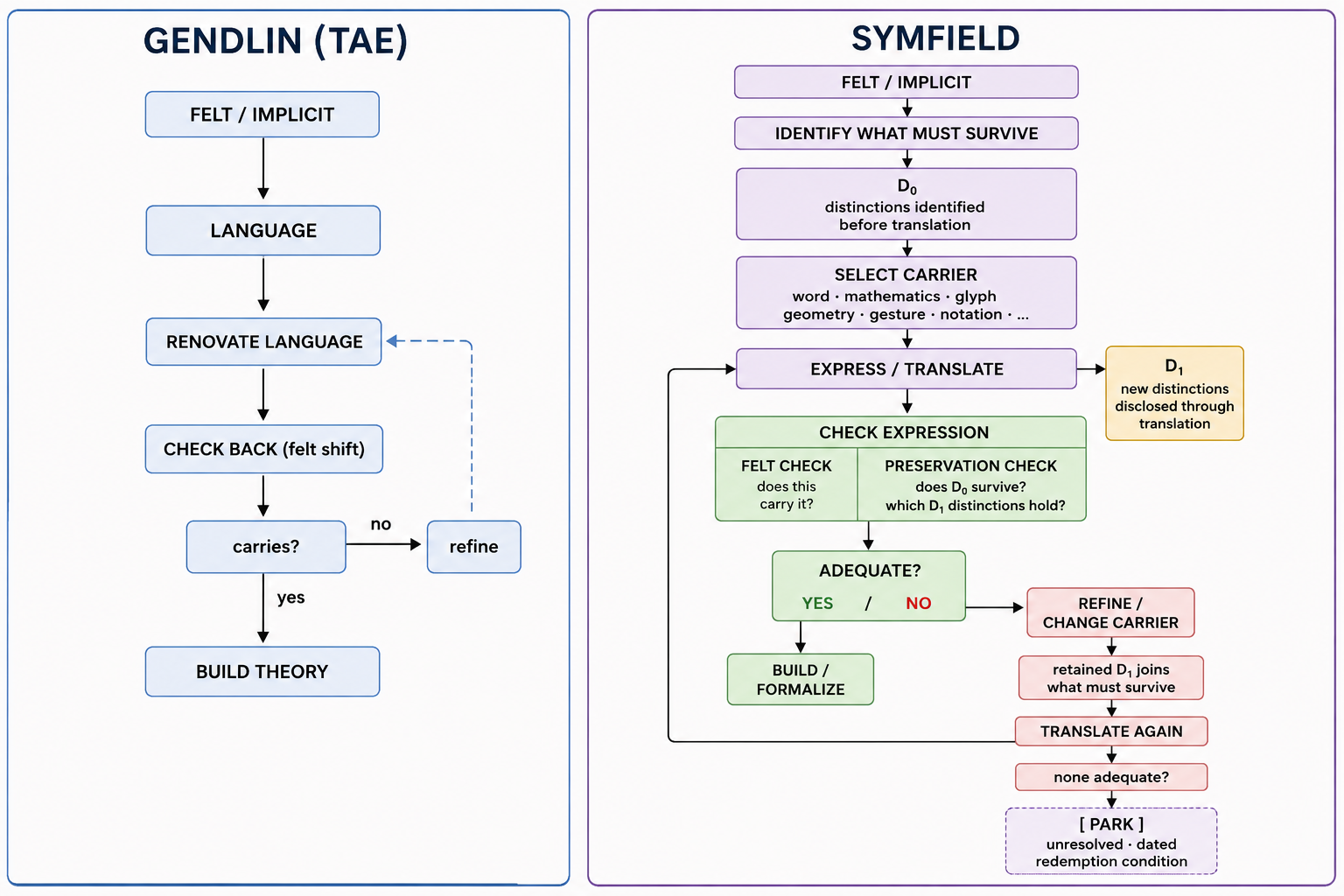
In plain language, the two objects that matter in the diagram are simple. D₀ is what must survive translation. D₁ is what translation itself discloses.
And of course all I can think of is slime mold.
Physarum polycephalum solves mazes with no brain and no map. (also sounding very quantumy) It extends itself through its environment, and distinctions emerge through the extending, where the food is, which routes carry flow, which terminate. It does not first construct a representation and then act upon it. Its body is perceiving, expressing, and mapping in the same medium. Paths that work strengthen; paths that do not withdraw. In that sense it offers a strange limit case for D₁: distinctions disclosed through the act itself. There is almost no carrier problem, because perception and expression have never been pulled apart.
Humans have that seam. We can apprehend something without yet being able to carry it adequately into language. Gendlin built Thinking at the Edge precisely there. Symfield begins at the same edge but widens the carrier set. Language is one possibility among others:
𝒞 = { language, mathematics, glyph, geometry, gesture, notation, … }
The operation is to identify what must survive, choose or construct a carrier, translate, and then ask two questions: did D₀ survive, and what D₁ did the translation disclose? What survives one translation becomes part of what the next must carry:
D₀⁽ⁿ⁺¹⁾ = D₀⁽ⁿ⁾ ∪ D₁*⁽ⁿ⁾
where D₁* is the portion of D₁ that survives the preservation check. Translation can also disclose artifacts of the carrier, and those are not carried forward. Where no available carrier is adequate, the remainder is not forced into form. It is parked, intact enough to be returned to.
We are not built like this. Our perceiving and our saying come apart, and the edge Gendlin found, the edge this whole essay walks, is that seam. The slime mold is what thinking looks like where the seam never formed. It has been running this architecture for millions of years, without one word.
Gendlin identified and operationalized thinking at the edge of linguistic formulation. Symfield proposes a more general architecture in which formulation itself becomes a carrier-selection problem: determine what must survive, select or construct a carrier, test whether the required distinctions survive translation and what new distinctions translation discloses, and preserve unresolved content rather than forcing collapse. If restricting that architecture to language recovers TAE, TAE becomes the linguistic boundary case of the larger instrument.
Further, not different
Two methods for one edge. Restrict the Symfield carrier set to a single element, {language}, and my claim is that what remains should be recognizably his ladder, the felt sense, the fresh phrasing, the checking-back, the crossing of instances. If the recovery holds, TAE is what my instrument reduces to at the language boundary. It is the signature move of everything I build. The Symfield Navier–Stokes framework recovers the classical equations exactly when the memory terms vanish. Symfield's Tolerance-Modified Exactness recovers ordinary homology at zero tolerance. I do not replace classical objects; I generalize them and prove the classical case falls out at the boundary, because that is how I want to honor an ancestor: not by claiming resemblance, but by showing recovery.
Language remains a carrier, but it is no longer the assumed destination. The felt-shift checking loop remains whole. What widens is the carrier set and the architecture around expression. Translation must preserve distinctions already found, but translation may also disclose distinctions that were previously implicit, an operation strikingly close to what Gendlin called carrying-forward. What survives one round becomes part of what the next round must carry. And where no current carrier can do so adequately, the remainder is not forced into form. It is parked, with what has been learned about it intact. And the obligation: show the recovery. A generalization claim earns nothing until the restriction is demonstrated. There is work ahead.
At the edge
Finding Gendlin gave me an ancestor. There is a peculiar feeling meeting someone who stood where you are standing, recognized the same problem, and built from it in a direction you did not. The first can close a line of inquiry. The second opens one. Gendlin gave language extraordinary room to move. I want to know what happens when the carrier is allowed to move too.
The rest has to be demonstrated, but I experience relief right now.